President Carter: The White House Years

by Stuart E. Eizenstat

For good or ill, Carter’s presidency was foreshadowed by the way he governed in Georgia. He showed his determination to address tough issues by abolishing and combining three hundred state agencies, boards, and commissions into twenty-two. At the same time, he left the necessary backroom bargaining with the state legislature to Bert Lance, his highway commissioner, allowing Carter to avoid the messy political compromises he found distasteful. Bert was all too happy to promise new or repaired roads, highways, and bridges to win over recalcitrant legislators.
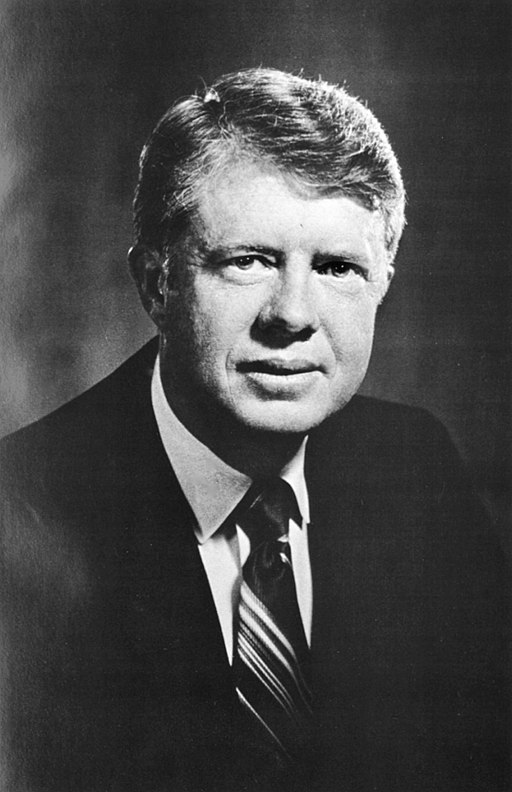
Jimmy Carter in 1971 as Governor of Georgia. Image is in the public domain via Wikipedia.

Carter also showed his commitment to the environment by an unprecedented decision (with shades of the water wars he would fight in Washington) to block the Sprewell Bluff Dam, a job- and park-creating project of the Army Engineers that would have damaged the swamps, streams, and wild rivers Carter prized as God’s creation. No governor in any state had ever blocked a water project fully paid for by the federal government. His willingness to take on vested interests, combined with his stellar civil rights record, made it unlikely that he would have been reelected if the Georgia Constitution had permitted governors to serve two consecutive terms. But Carter was already setting his sights higher than that.

Shortly after his inauguration as governor in January of 1971, the presidency of the United States clearly was coming onto Carter’s personal horizon, although among his cronies and even in the privacy of their fishing trips the only term they used was “national office.”  Indeed, Carter was so determined to become president that at the 1972 Miami Democratic Convention, he instructed Ham to start a movement to promote him as Senator George McGovern’s running mate, even though he had been a leader in the anti-McGovern elected officials at the convention. Ham recalled that when they went to Miami they “had this crazy idea of getting Carter on the ticket as VP. We tried to have it both ways. We tried to get on the ticket but not get caught trying.” Chance favored Carter in McGovern’s crushing defeat. He also met Patrick Caddell, McGovern’s brilliant young pollster, just out of Harvard and already a major figure in national Democratic politics—but not to the taste of Kirbo, who recalled that it was “the first time I saw that damn pollster with the long hair.” But gradually the Carter team coalesced into a fighting force with awesome political skills.

Carter’s ambition to gain the presidency was reinforced by measuring himself against the stream of potential candidates who visited him at the governor’s mansion seeking his support. He remembered that “after spending several hours with them drinking beer and so forth, I didn’t see that they were any more qualified than I was… I was amazed at how parochial they were and how narrow-minded they were.” As governor, he had to implement laws they had put through Congress, which Carter said they could barely remember. Still, it seemed presumptuous—even absurd in Ham’s view—for Carter to think or at least talk openly about the presidency until prompted by supporters outside his inner circle. The first formal memorandum came from Dr. Peter Bourne, a physician who had helped draft speeches for Carter’s gubernatorial campaign. With the Vietnam War dragging to a close and Watergate further coloring the voters’ suspicion of Washington, Bourne correctly realized that the forthcoming 1976 presidential campaign might be a time for an outsider with a fresh approach. He wrote Carter a long letter in the summer of 1972, arguing that this was his moment and that he needed to start building a political base. He urged him to travel the country campaigning for Democratic congressional candidates and to write an autobiography; Carter did both.

This sparked a series of meetings in Atlanta throughout the 1972 presidential campaign with Ham, Rosalynn, and his cousin Don Carter, a journalist with Knight-Rider newspapers. The regulars at the mansion joined in. On October 17, Ham started off lightly: “Governor, we have come to talk to you about your future. I don’t know any other way to say this, and it’s hard to bring myself to say the words, but I guess I will just have to say it.” After hesitating for a second, he got it out: “We think you should run for president.” Carter put off his decision until the day after McGovern’s overwhelming defeat. When she realized he intended to run, Rosalynn called his sister Ruth and exclaimed, “ ‘Jimmy’s going to run for p-p-p… ’ I couldn’t even say the word, it was so unreal to me.” On November 5 he convened another meeting of his inner circle at the mansion; they realized they needed a concrete plan, and Carter asked Ham to pull together all the ideas in their recent meetings into one memorandum. The result was Ham’s seventy-two-page outline of his brilliant strategy for catapulting the unknown governor of a medium-sized Southern state to the White House. It became one of the most famous campaign blueprints in modern American political history.

Watch the official book trailer for President Carter: The White House Years


STUART E. EIZENSTAT has served as U.S. Ambassador to the European Union and Deputy Secretary of both Treasury and State. He is the author of Imperfect Justice and President Carter. He is an international lawyer in Washington, D.C.

The post President Carter: The White House Years appeared first on The History Reader.

Powered by WPeMatico
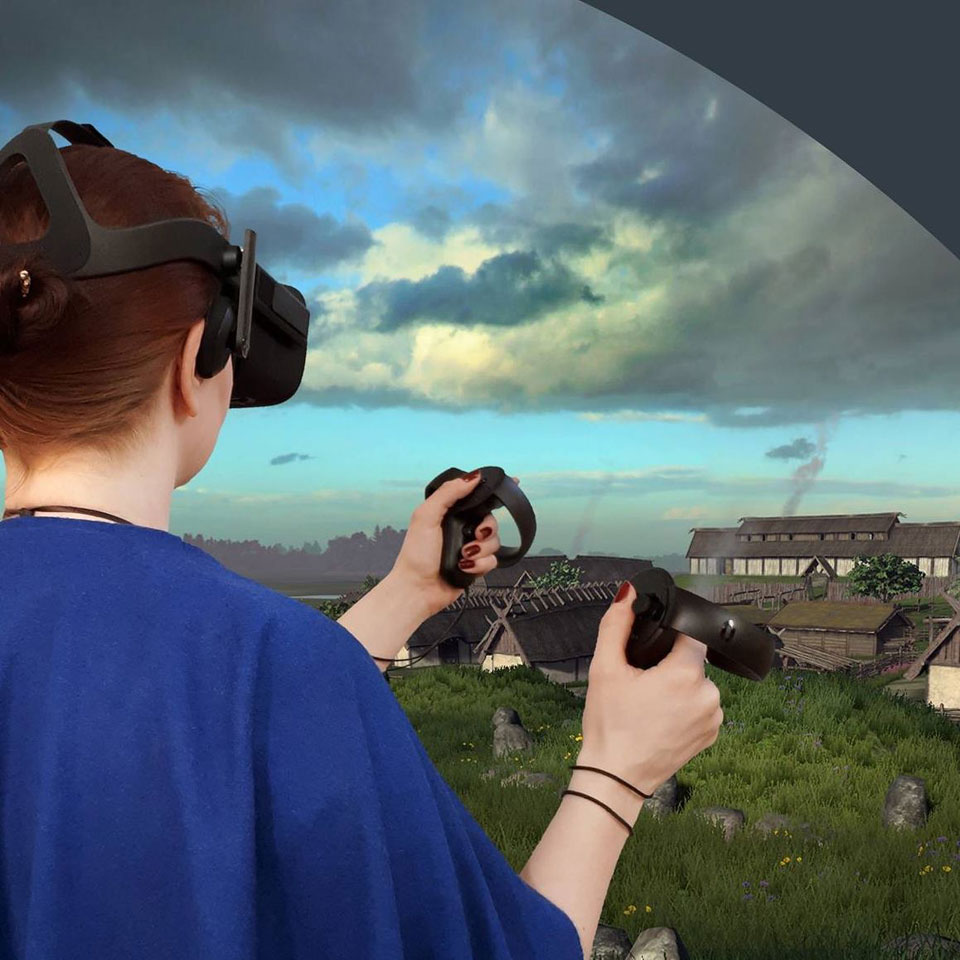
Old Uppsala Visualized

Now gone, the plain surrounding Old Uppsala c. AD 650 was not only marked by the burial mounds but also dotted with halls, an impressive parkway and a surrounding marketplace. New Virtual Reality reconstruction lets visitors walk the landscape

Exploring Old Uppsala via Virtual Reality
Exploring Old Uppsala via Virtual Reality © Uppsala Museum/ Disir Production

In its heyday, Old Uppsala was a prominent royal centre with impressive mounds, a grand hall covering more than 600 m2, an impressive two km long passage bordered by posts and a nearby marketplace. A visit to Old Uppsala is a must for anyone interested in the early Scandinavian world of Beowulf. With the mounds and the later church, the sacral landscape witness to a shifting settlement stretching through millennia. The museum offers a fine introduction as well as an exhibition of the outstanding finds from the archaeological excavations, which have been carried out since the end of the 18thcentury.

Recently, the Museum in Old Uppsala launched a gadget, which brings the visitor closer to experience the site around AD 650. The new VR-gadget allows for the visitor to kindle a fire, greet the sword maiden, pick up artefacts and in general interact with the world as it once was.

The new VR tour is an extension of an app, which was launched in 2016 and which allows for a virtual visit on your IOS device (Ipad or iPhone). The new gadget, however, allows for a better immersion for people who are not able to visit the site or wish for a real time-travel experience.

The VR-gadget is developed by John Ljungquist, assistant Professor at Uppsala University, co-founder of Disir Production.

Another project offers the possibility of visiting Uppsala Cathedral in AD 1509.

SEE MORE:


The post Old Uppsala Visualized appeared first on Medieval Histories.

Powered by WPeMatico

Astonishing Viking Silver Hoard discovered at Rügen in Germany

A few days ago, a 13-year old girl discovered an extraordinary Viking silver hoard with the largest number of so-called cross coins from the reign of Harold Bluetooth.

Cross Coins were minted by Harold Bluetooth c. AD 975 – 90, probably in Haithabu: It is believed that these coins represented the first initiative to mint a regal and managed coinage in Viking Scandinavia. Although coins had circulated since the 8th centuries in numerous of the Viking market towns, most Vikings would use silver as a weighted treasure when trading, doing commerce or building social networks through gifts.

Most hoards from the Viking Age would, therefore, consist of a mixture of hack silver and tested and split coins; just as is the case with the present hoard. In the late 10th century, however, numerous hoards in present-day Denmark would also contain so-called cross coins, unhacked and unharmed. Why is that?

Background

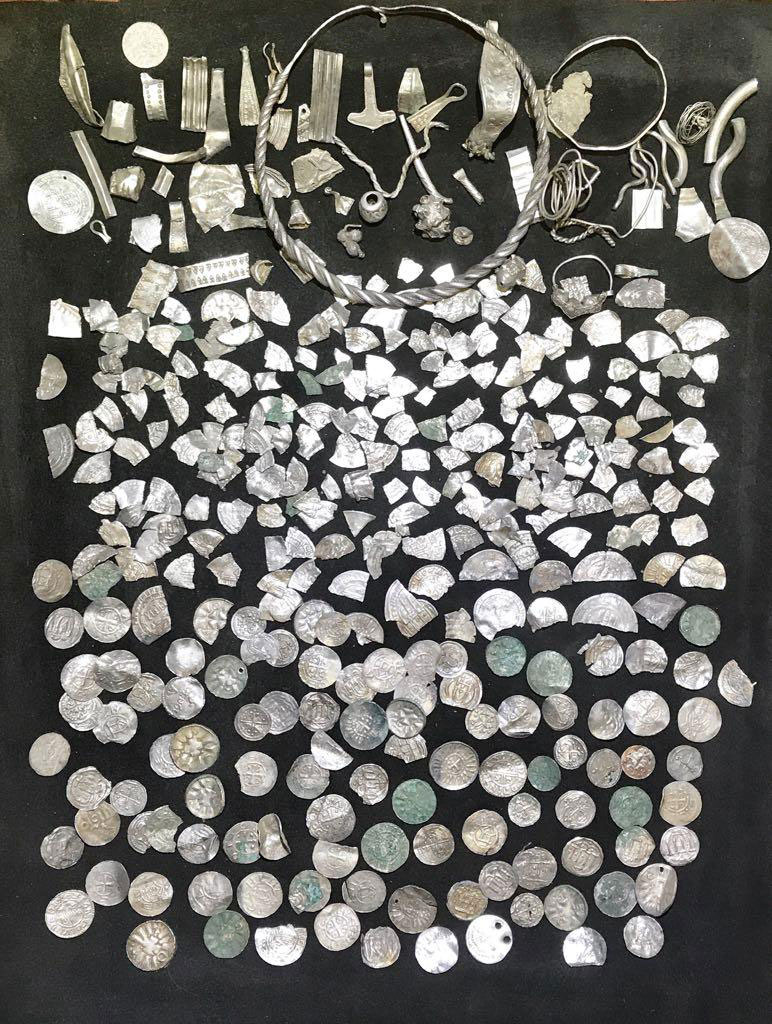
Hoard from Rügen 2018 with Cross Coins from the reign of Harold Blutooth © Landesamtes für Kultur und Denkmalpflege

After AD 963, when Harold Bluetooth converted to Christianity and was baptised, he waged a “cold” war against the large German Empire down south. Part of his effort to keep the Empire at bay consisted in the construction of the magnificent ring fortresses, located inland at strategic places. It is likely they were primarily meant to stock victuals to feed his army. At the same time, he mounted an impressive symbolic manifestation as witnessed by such monuments as Jelling and the bridge at Ravninge. The Danish historian Jens Christian Moesgaard has recently argued in a book that we should understand the Cross Coinage as part of this communicative effort. Thin and not very valuable in terms of their silver-content, they are nevertheless preserved in numerous hoards without having been hacked or split. Likely, they figured as the “King’s money” as payment for soldiers and builders, symbolically sending the message about the new faith of the King and his realm as well as his status as a king with a professionally managed mint. From these payments, the coins seem to have strayed into wider commercial contexts. Accordingly, we know of these coins from single finds in Denmark as well as hoards consisting of hack silver, jewellery and unblemished coins.

The newly found hoard from Rügen belongs to this same category. As can be seen from the initially posted photos, it contains hack silver, jewellery, pecked and tested coins as well as an impressive number of so-called cross coins. Whether all of these are unblemished is not known at present. All-in-all c. 500 – 600 coins have been found, including app. 100 coins belonging to the Cross Coin type. It weighs c. 1.5 kilograms.

Because of the cross coins and their connection with Harold Bluetooth, the media have identified the newly found hoard as the King’s treasure hidden while he was fleeing from the civil war, his son started in the mid-80s. According to later sources, Harold died of his wounds near Jumla, where he was presumably buried.

This interpretation is unlikely. The hoard is not that valuable. More likely, it belonged to a Viking employed in Harold’s army or one of his building projects. Much more, though, will be known when archaeologists and numismatists have had the time to study the hoard in details.

SOURCE:

Silberschatz aus der Wikingerzeit auf Rügen entdeckt

READ MORE:

King Harold’s Cross Coinage: Christian Coins for the Merchants of Haithabu and the King’s Soldiers
By Jens Christian Moesgaard
Publications from the National Museum:
Studies in Archaeology & History Vol. 20:2
University Press of Southern Denmark 2015


King Harold Bluetooth’s Cross Coinage


Harold Bluetooth’s Cross Coins and a Newly Found Viking Hoard


The post Astonishing Viking Silver Hoard discovered at Rügen in Germany appeared first on Medieval Histories.

Powered by WPeMatico

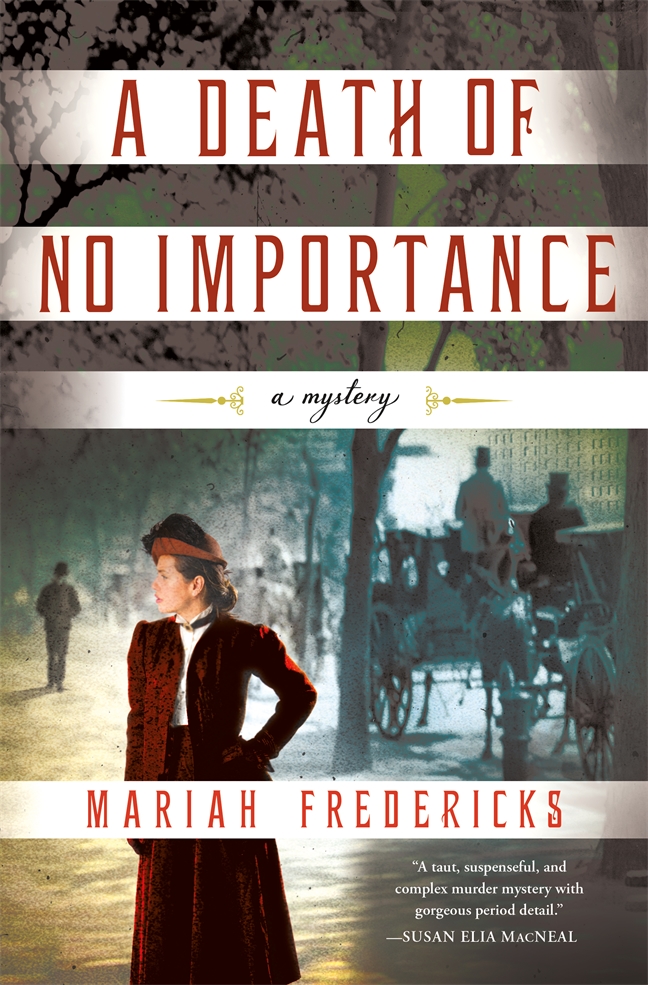
The History Behind the Mystery: A Death of No Importance

by Mariah Fredericks

One of my favorite books as a kid was an illustrated chronicle of famous disasters. Pompeii, Titanic, the Chicago Fire.  I loved that book. I wore it out. The spine was cracked; the pages came loose. I put them back in, mixing the Hindenburg with the Black Death. One of the last events in the book was the Triangle Shirtwaist Factory Fire. That event always felt different to me. The fire happened in New York, about four miles from my house. The majority of those who died were young women only a little older than I was. They weren’t glamorous like the Titanic victims. No Hollywood star has ever portrayed them. They were just going to work. For 12 hours a day.

And on March 25, 1911, they died in the worst workplace disaster in the city’s history. The New York Times wrote, “Scores of working girls were hemmed in aisles formed by wooden sewing machines and filled with flimsy materials. More than fifty jumped from a window to be picked up either dead or fearfully injured. Many others were literally roasted to death.”

“Shirtwaist kings” Max Blanck and Isaac Harris had refused to allow a union or to improve working conditions. One elevator out of the four worked, and it could only take 12 people at a time. One door to the outside was locked to prevent theft, and the other opened in. The indoor fire hose was rotted, the valve rusted shut.

The idea for A Death of No Importance came to me when the first line, “I will tell it,” popped into my head. I didn’t know who the “I” was and I didn’t know what she had to say. But she kept coming back, and over time I figured out it was a she, not rich, probably a servant—someone not used to being heard. Her language was somewhat formal, what I might call old-fashioned. She had to be a New Yorker because I’m a New Yorker. Not modern… but on the brink of modernity. Which brought me to slightly before the outbreak of World War I—and the Triangle Shirtwaist Fire.

The book is called A Death of No Importance because as a society, certain deaths loom large and some seem to matter not at all. You could argue that the lives of the Triangle workers did not matter much to their employers; their deaths actually wound up as a profit once the insurance came in. But in the wake of the tragedy, new laws regarding building safety and workers’ conditions were passed—and actually enforced. The deaths of these women and men have mattered enormously to workers who came after them.

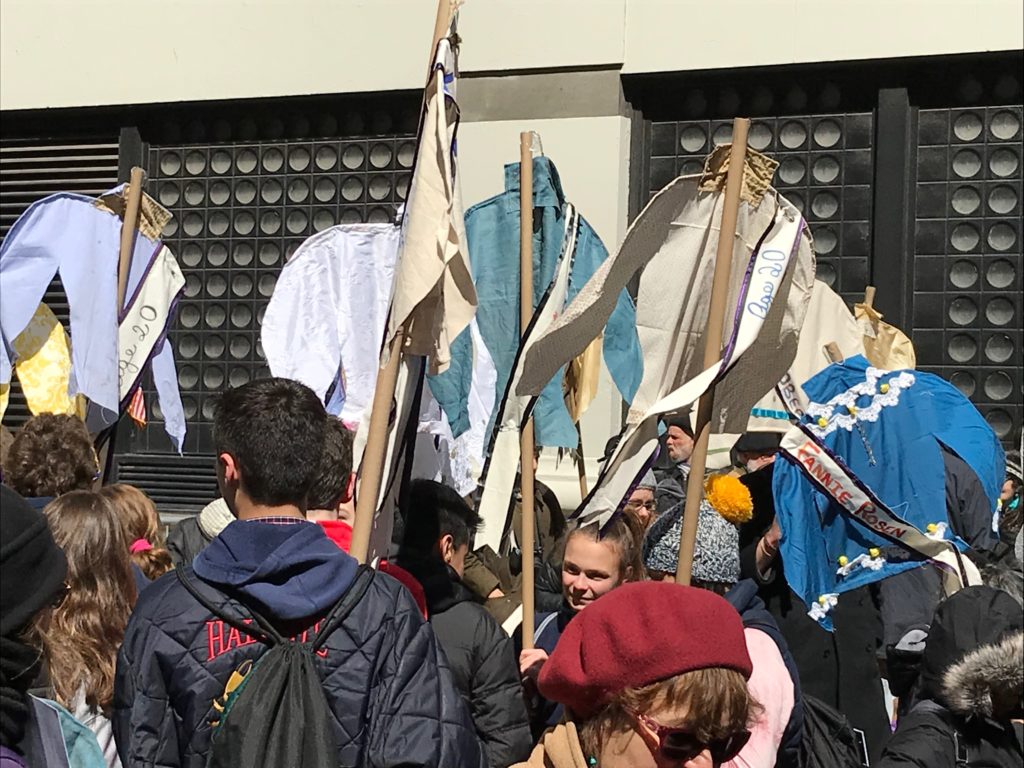
Banners representing the workers who lost their lives in the Triangle Shirtwaist Factory Fire in 1911.

On March 23, I went to a ceremony organized by the Remember the Triangle Fire Coalition. It is held every year at the foot of the Asch Building—now the Brown Building—where the workers died. A crowd of a few hundred people was gathered, many carrying banners in the shape of shirtwaists, each bearing the name and age of a Triangle victim. Fannie Hollander, 18. Annie Starr, 30. Esther Hochfeld, 21. In some cases, the banners were carried by a descendant of Triangle workers.

The ceremony kicked off with rousing songs from the New York City Labor Chorus. Ladder 20 of the New York Fire Department raised its ladder to the 6th floor of the building. In 1911, fire ladders could only reach the 6th floor, so they were unable to reach the fire on the 8th, 9th, and 10th floors. The chasm between the workers and rescue was made horrifically clear. Just the night before the rally, FDNY Lieutenant Michael Davidson had lost his life fighting a fire in Harlem.

In 1911, fire ladders could only reach the 6th floor, so they were unable to reach the fire on the 8th, 9th, and 10th floors of the factory.

White and red carnations were laid at the base of the building as the names were read aloud. That weekend, people were due to march for gun safety laws and the Parkland students were very much on people’s minds, as speaker after speaker pressed the need for laws that would ensure that people could go to work—or school—and return home safe.

Plans for a permanent memorial to the Triangle workers are underway. In a city that has erected statues to Teddy Roosevelt, George M. Cohan, and Sir Walter Scott, it seems more than fitting that we remember the 146 workers whose deaths gave us so many of the labor protections we take for granted today.


MARIAH FREDERICKS was born and raised in New York City, where she still lives with her family. She is the author of several YA novels. A Death of No Importance is her first adult novel.

The post The History Behind the Mystery: A Death of No Importance appeared first on The History Reader.

Powered by WPeMatico
The Time of the Sueves in Iberia AD 409–585

The exhibition, In Tempore Sueborum, invites us to explore the life and times of the Suevi and how they lived together with the Gallo-Romans in Late Antiquity in the northwest corner of the Iberian Peninsula, where the Suevi settled after AD 409.

The exhibition, In Tempore Sueborum, is organised at three different venues in the Marcos Valcárcel Cultural Center, in the church of Santa María Nai and the Municipal Museum in Ourense. It represents a remarkable effort to gather numerous very precious artifacts from all over Europe in one place. A trip this spring to Ourense, provides an opportunity to see the Ring of Alaric, the Culdron from Mušov, and the diadems from Beiral and Mérida in one place.

Marcos Valcárcel – the History of the Sueves

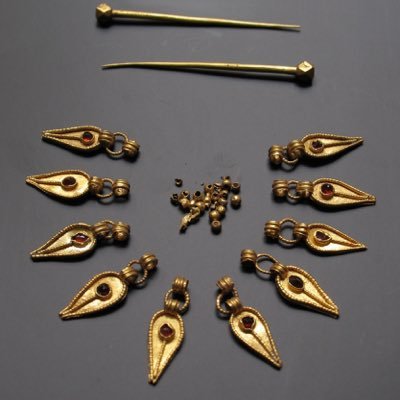
Necklace and hairpins (?). Mérida © Museu Nacional de Arte Romano in Mérida

In the Marcos Valcárcel, we invited to explore the complex process preceding the arrival of the Suevos in Galicia. This process took place between the fourth and fifth centuries and led to the creation of the Suevic Kingdom, which controlled the northwest between AD 411 and 585. It was the first barbarian kingdom in the West, a pioneer for the successor kingdoms of the Middle Ages, and a precursor of the political configuration of today’s Europe.

The exhibition aims not to tell the story in the usual way focusing on “The Decline and Fall of the Roman Empire” but rather present the “new” story, which has revealed itself through archaeological excavations and renewed reflection upon the scarce sources since the end of the 20th century.

Before this, history told the story of the “Barbarian Savage”, who – uncivilised and clad in pelts –invaded Western Europe as part of the “Great Migrations”. Careful sifting of the preserved sources has yielded a much more nuanced version, in which the Germanics lived in wide-ranging and very permeable frontier-zones bordering the Roman Empire. Living here, they supplied manpower in the form of Roman Mercenaries as well as a vibrant market for Roman luxury items. Slowly, during the 3rd and 4th centuries, a lively interplay evolved in and around the Limes and its neighbouring provinces characterised by a mixture of trade, skirmishes and occasionally wars. In this way, the Germanic rulers obtained an elite lifestyle inspired by the Romans, but with a distinct “Barbarian” Twist – as witnessed by the production of glass drinking horns produced for the wider Germanic market at Cologne. Another example is represented by the cauldrons with Suevic heads embellishing the handles, the Mušov and Czarnówko cauldrons, both found in Germanic graves. Such cauldrons or buckets were Germanic “copies” of traditional Roman and Greek cauldrons or situlas fitted with handles depicting Roman Gods.

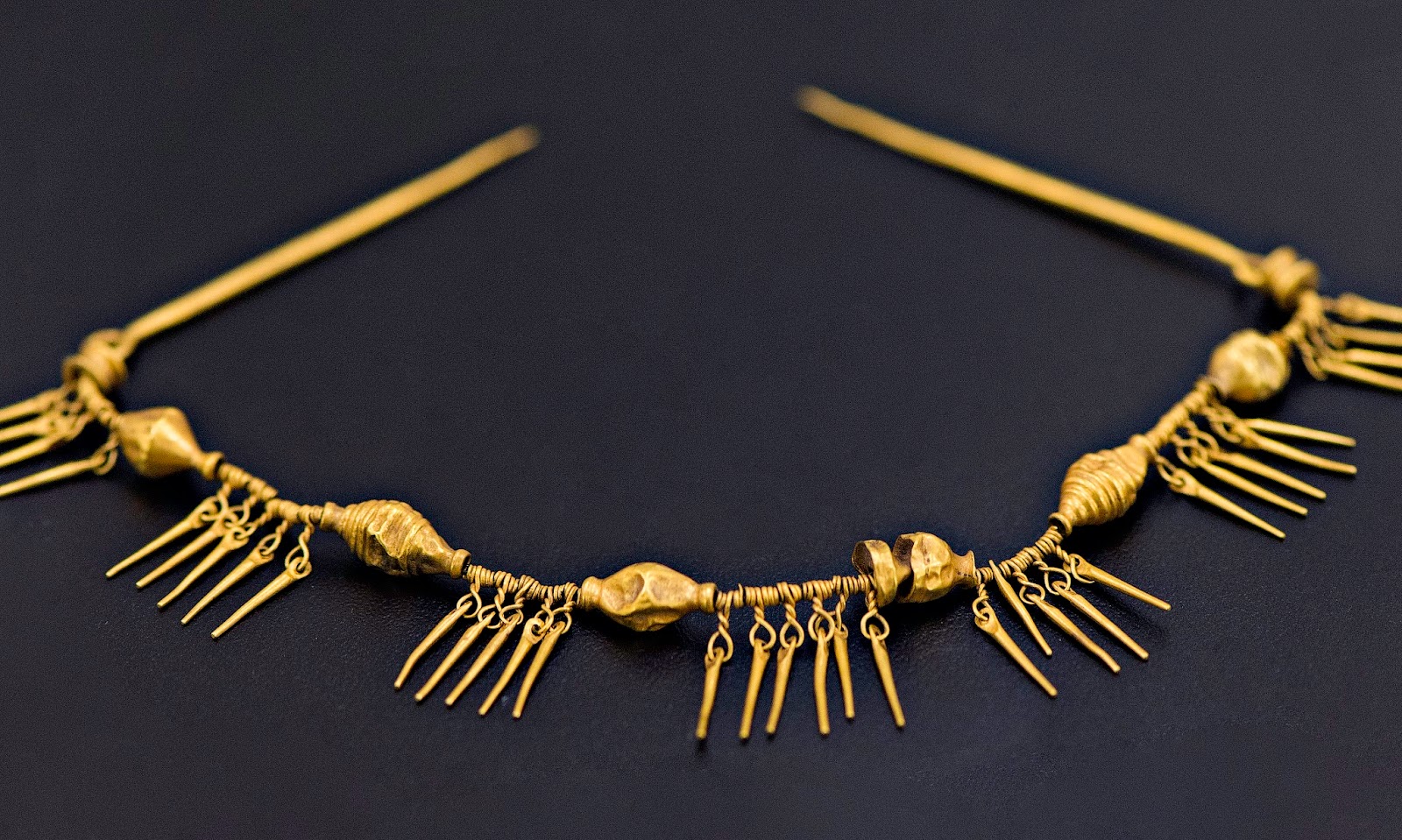
Diadem from Beiral do Lima (Ponte di Lima) © Museo de Etnologia do Porto

Such Barbarians lived and were buried far from the Roman Empire. Others, though, apparently settled inside the Roman Empire while obtaining land, status and social prestige. Some would even end up as generals employed in the Roman Army. For them Rome constituted a model and an ideal, to imitate and not to destroy.

However, at the end of the 4th century, the Huns invaded Southern Europe pushing larger groups of people in front of them. Perhaps amounting up to hundreds of thousands of men, women and children, these fugitives spilt over the Danube and Rhine. It is likely the size of these throngs of people posed the Romans with insurmountable challenges. Formerly, such bands of people had successfully been split up and spread out over the wider Roman Empire with the men press-ganged into the Roman Army. Now, however, the multitude of people posed a gargantuan task. In the end, both the Goths and later the Vandals, Alans and Suevi were allowed to settle together.

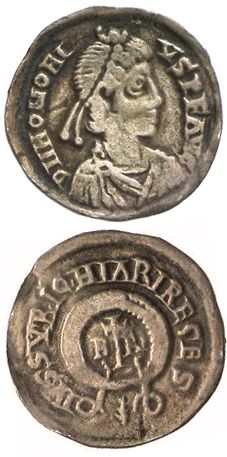
Thus, when more than 200.000 people crossed the freezing Rhine on New Year’s Eve in AD 406 to cross the Pyrenees a few years later, they ended up as distinct “bands of brothers” who settled in Spain. In this process, they also began to be defined and define themselves as tribes and/or distinct aristocratic groups. It is as such, we encounter the Suevi in the northwestern corner of Iberia, in the Roman province of Gallaecia. Led by a powerful Germanic chieftain, Hermeric (AD 409 – 438/41) they chose Braga as their regional centre and initiated the business of consolidating their power base through treatises, marriages, and pillaging. While Hermericus was a pagan, his grandson, Richiarius (448 – 56) was baptised as a Catholic albeit married to an Arian princess (from Toulouse). In 456 he was defeated by his brother-in-law, thus seeing their political influence curtailed severely. During the following decades, numerous kings held sway until the Visigoths finally wiped out the Suevic kingdom in AD 584.

Iberia c. AD 438
Iberia c. AD 456 - 584

Santa María Nai – Christianisation in Gallaecia

Although a gradual process of Christianisation took place in the 4th century, the primary evidence stems from the 5th century during which the pagan Sueves and Arian Visigoths operated in the Catholic vestiges of the 4th-century missionary field. To complicate matters further, several heresies were bitterly fought over, foremost the gnostic Priscillianism. In this religious hotbed, written sources reveal a continuous fight over organisation, liturgies, so-called folk-religious practices etc.

Many of these processes are especially well documents in the crucible of Suevic Galicia, where the Galician-Roman and Hispanic-Roman aristocracy tried to establish an ecclesiastical and administrative organisational platform, gradually moving from an urban and semi-unban context and into the rural countryside. Primarily the work of Martin of Braga – known as the Apostle of the Suevi – has set its mark on the understanding of the events and the rhythm of the process. A unique source in this context is the so-called “Suevic Parish List” from c. 570 – 80, listing 13 episcopal seas and 132 parochial churches. This part of the exhibition presented in Santa María Nai showcases remains of religious art from the 6th and 7th centuries.

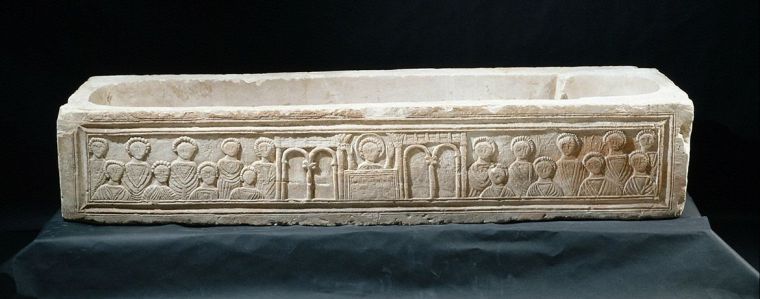
Copy of tomb of St. Martin of Braga. Original in Dume, Portugal

Municipal Museum of Ourense – Suevi and Gallo-Romans

Coin minted in Braga Probably in commemoration of of the "coronation" of Rechiar in c. AD 451.
Coin minted in Braga. Probably in commemoration of of the “coronation” of Rechiar in c. AD 451. © Staatliche Museen zur Berlin

The question is: how did the Suevi and the Gallo-Romans live alongside each other? And what changes took place in the landscape. These questions are explored in the final part of the exhibition at the Municipal Museum in Ourense.

The late 4th century in the still Roman province of Hispania experienced a marked renovation. After a period of economic deterioration, cities were rebuilt, and villas were expanded and redecorated. Slowly, though, the centres of cities were no longer focused on the Forum and the immediate surroundings. Instead, the new episcopal centres began to set their mark. Also, in the 5th-century burials were no longer uniformly located outside towns and settlements. Gradually, they became relocated to cemeteries close to churches and basilicas and inside the walls of the fortified cities.

In the countryside, people seemed to move from the Roman villas to higher ground in the 5th and especially the 6th century. Or they settled in what for want of a better word might be known as villages – smaller, larger, oblong or concentric. The large urban conglomerations – Lugo, Astorga, and Braga – continued to function as urban centres. Excavations in later years have documented that vigorous and far-flung trade with luxurious goods persisted. Thus, at Tintagel in Cornwall – http://www.medievalhistories.com/luxury-tintagel-early-medieval-period/ -, recent excavations have uncovered that the British people enjoyed wine from Turkey, olive oil from Greece, and pottery and glass ware from Africa and indeed Iberia. Presumably, ships continued to ply the waters along the Atlantic coast, while using the Galician seaports as stepping stones. Spectacular finds from the excavations of the harbour at Vigo (the Vicus Spacorum) have provided findings that show the scope and intensity of this very dynamic trade in ceramics, wine, olive oil, alum as well as wood, leather, and metals (tin and gold). Even though artistic output in this period was sparse, people seemingly thrived while inventing the new post-Roman world.

Catalogue

The exhibition is accompanied bu a catalogue in Spanish and English

VISIT:

In Tempore Sueborum
Ourense
15.12.2017 – 06.05.2018

SEE MORE:

The post The Time of the Sueves in Iberia AD 409–585 appeared first on Medieval Histories.

Powered by WPeMatico

The Making of a Legendary American Film

by Don Graham

When George Stevens picked Rock Hudson to play rancher Bick Benedict in the big new film that everybody in Hollywood was buzzing about, the actor couldn’t have been happier. He was “walking in clouds,” he wrote Stevens in late November 1954.

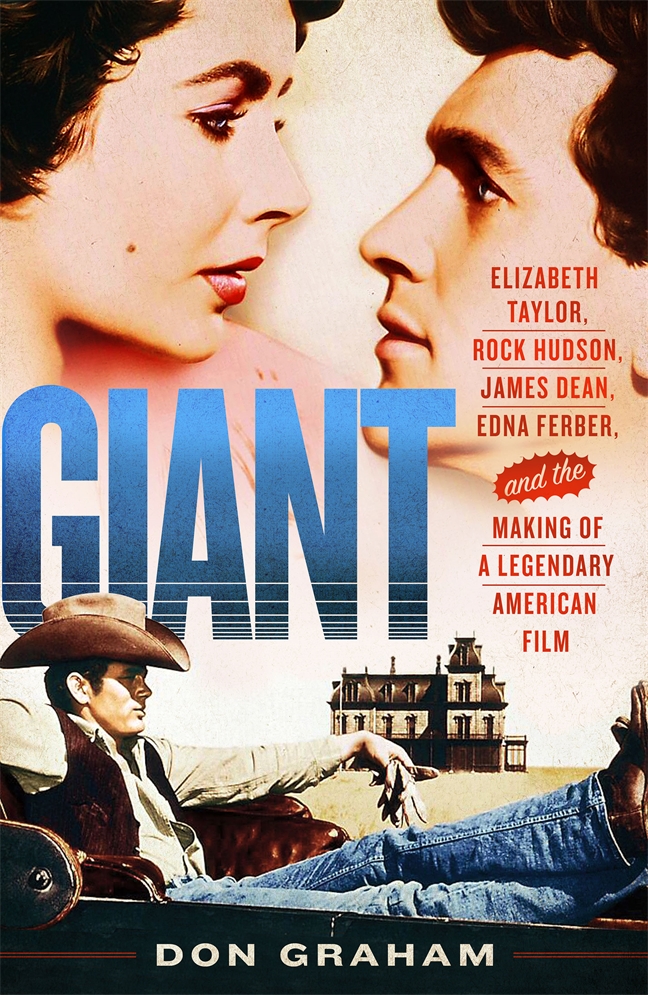
Theatrical release poster for Giant. Image is in the public domain via Wikipedia.

It was a long road that led to Hudson’s selection. Stevens began casting near the end of 1953 and didn’t arrive at a decision on who would play Bick Benedict until a year later. Stevens went about the process with his usual thoroughness. He created a kind of Texas bazaar in his office at Warner Bros., with photographs and articles about Texas posted on the walls. He wouldn’t have any trouble finding materials. As Edna Ferber wrote, “Texas of the 1930s and 1940s was constantly leaping out at one from the pages of books, plays, magazines, newspapers. Motion pictures of Texas background were all cowboys and bang-bang, Texas oil, Texas jokes, Texas money billowed out of that enormous southwest commonwealth.” Ferber was right on all counts. Texas had been a movie state from the earliest days of film, going all the way back to 1908’s Texas Tex (shot in Copenhagen, Denmark!). In the run-up to Giant, Hollywood pumped out sixty-three films about Texas from 1950 to 1956, almost all of them shot on studio back lots.

Stevens, however, wasn’t sure how to represent the Texas type, and in October 1954, he placed a call to John Rosenfield, longtime arts critic of the Dallas Morning News. He thought Rosenfield might be able to help. “You know, I don’t know what a Texan looks like. I’m afraid that if I follow my ideas I will show types that Texans will hoot at.” What he wanted, he went on, was “a good portrait artist who will visualize six leading characters for me.” Furthermore, he added, “I want him to do this without any reference to established movie stars.”

Rosenfield knew just the man, Edward Bearden, a Dallas artist and former member of the SMU faculty. At Stevens’s bidding, Bearden drew the six key figures: rancher Bick Benedict; his wife, Leslie Lynnton; Jett Rink, the poor ranch hand who strikes it rich; Luz Benedict, Bick’s cantankerous sister; Uncle Bawley, a wise old bachelor; and Old Polo, the vaquero caporal (foreman). Stevens felt it was imperative to have a Texas perspective, and Bearden gave him that. Delighted with the sketches, Stevens posted them outside his office and distributed copies to casting agents and the press.

Stevens also valued Ivan Moffat’s incisive prose profiles of the principals in the story. Moffat’s insights into character and motive were striking. Typical is this probing analysis of Bick Benedict: “Perhaps deep down Bick had long known that some of his views were wrong and that Leslie was right in her point of view, but he never admitted it. He indulged to his own considerable satisfaction in unfavorable comments about the appearance of his half-Mexican grandson, and relished doing so all the more because he had a sneaking feeling that in actual truth the mixture of his blood would be a pretty good one.”

With Bearden’s drawings and Moffat’s verbal descriptions as guides, Stevens directed his search for actors along those lines. He preferred choosing actors instead of holding auditions. Having grown up in a family of actors, he knew the humiliations associated with auditions. And in casting Giant, he had an abundance of eager talent. Just about every leading man in Hollywood felt he was perfect for the role of Bick Benedict.

After all, most of them had already played Texans in one film or another. Clark Gable, Gary Cooper, Charlton Heston, William Holden, Robert Mitchum, Joel McCrea, Sterling Hayden, Errol Flynn, Robert Taylor, and Forrest Tucker—all had donned chaps and Stetsons, holstered their side- arms, mounted their trusty steeds, and ridden off to some studio backlot Texas town to save it from desperadoes waiting for a train.

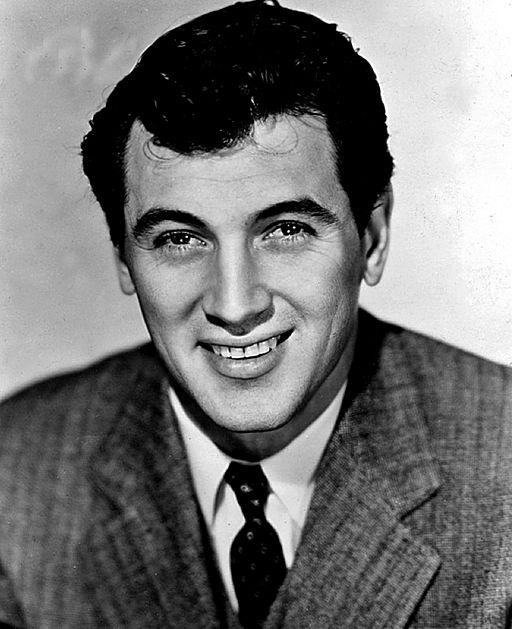
Publicity photo of Rock Hudson. Image is in the public domain via Wikipedia.

And so the suitors presented themselves. They telephoned, they wrote, and they visited the Warner Bros. lot. Early hopefuls included Gable, Cooper, Holden, Mitchum, and Hayden. With all that talent around, Rock Hudson wasn’t even in the running in the beginning. But from Stevens’s perspective, all the other aspirants faced an insuperable problem. They were too old. The storyline of Giant covered twenty-five years and whoever played Bick Benedict would have to transition from a young man courting a young woman to a graying middle-aged grandfather. For established male stars, it was a canyon too far.

Stevens believed it was easier to age a younger man than to make an older one appear younger. And he most certainly did not want to use two actors to convey the sense of aging.

Among the actors that Stevens did consider in the beginning are a few surprises. He briefly entertained the idea of Forrest Tucker, a rugged six-foot-four action star in not-so-great Westerns. The lead in Giant would have been a bigger boost for his career even than it was for Hudson.

Budgeting problems expanded the range of possibilities. Already worried about cost overruns, Warners had the studio casting department draw up a list based on box-office appeal. With John Wayne at the top, the roster included sixteen names, among them Jimmy Stewart, Henry Fonda, and Jeff Chandler. Some seem very implausible: Victor Mature and Cornel Wilde, for example. Edna Ferber’s favorite, Burt Lancaster, was never considered.

For a time, it appeared that Sterling Hayden might have the inside track. His agent lobbied hard for Hayden: “He has the great robust charm these ‘Texians’ seem to have,” but there again was the question of age. The agent thought that with a little makeup and the right clothes, his client could pull off the younger Bick Benedict. But Stevens rejected this argument: “It’s easier to believe a romance between young people than among older, more established stars.”

Gradually, Rock Hudson emerged as the pick.


Don Graham, whom the Dallas Morning News has called “Our premier scholar and critic on Texas literature, films and pop culture,” is J. Frank Dobie Regents Professor of English at the University of Texas at Austin. He is also a writer-at-large with Texas Monthly magazine. He received the Carr P. Collins Prize for Best Nonfiction Book of the Year, awarded by the Texas Institute of Letters, and has served as that organization’s president.

Don is the author of Kings of Texas and Giant.

The post The Making of a Legendary American Film appeared first on The History Reader.

Powered by WPeMatico
Minor Medieval News April 2018

Ever so often we stumble on some minor medieval news which do not merit a full article, but nevertheless, deserve a short notice.

Royal Armouries Collection in Leeds currently focus on the War of the Roses. Enjoy the Late Medieval Hightlights intheir collection

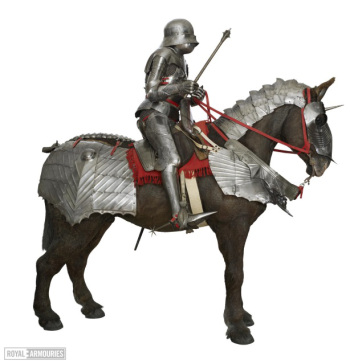
Gothic Armour from Royal ArmouriesThe Gothic Armour dating from the late fifteenth century is currently on display on the cruciform in the War Gallery in Leeds. The armour is called ‘gothic’ presumably because it was thought reminiscent of medieval ‘Gothic’ architecture. This particular armour is of German origin, it is more symmetrical than other European armours. A popular form of helmet in Germany was the sallet, this could be made from one piece with the sight cut into the front face or with a broad open face, over which a visor could be fixed. Sallets were often worn with a chin-shaped defence, called a bevor, although the sallet provided great protection, the bevor proved unpopular and there are many accounts of men slain in battle for not wearing their bevor or temporarily lowering it to help them breath. The Gothic Armour is currently on display together with a group of other weapons which were carried by soldiers, nobles and princes in this very bloody Late Medieval war.

Visit:

Royal Armouries in Leeds
Armouries Drive
Leeds, LS10 1LT United Kingdom

‘Arms and Armour of Late Medieval Europe’ by Bob Woosnam-Savage is available to purchase online and in the museum shop.


Save

Save

Save

Save

Save

Save

Save

Save

Save

Save

Save

Save

Save

Save

Save

Save

Save

Save

Save

Save

Save

Save

Save

Save

Save

Save

Save

Save

Save

Save

Save

Save

Save

Save

Save

Save

The post Minor Medieval News April 2018 appeared first on Medieval Histories.

Powered by WPeMatico