The Medieval Calendar in Books of Hours

For people in the Middle Ages keeping track of time was all important. One chalennge was to know when markets were held. Another when to sow, harvest and feast. Early on, the Church set up itself as timekeeper par excellence. But how did clerics keep the time? New book introduces the student to the intraicacies of medieval timekeeping.

The Medieval Calendar
Locating Time in the Middle Ages
By Roger S. Wieck
The Morgan Library and Museum, New York. In association with Scala Arts Publisher, Inc. 2017

Review

More calendars survive from the Middle Ages than any other type of document, writes Colin A. Baily in his foreword to a new book, published in connection with an exhibition at The Morgan Library and Museum in New York, spring 2018. This remark from the director of the museum is probably not entirely correct. Gospels, theological treatises and religious handbooks in the form of missals, breviaries and psalters – or for lay people, books of hours – would constitute the bulk. Calendars seldom constituted “books” on their own. As a matter of necessity, however, most of these types of books would also hold Easter tables and later calendars. The point, though, that these manuscripts often included or were organised as calendars, thus indicate that the observation is not far from the target.

The fact is, that time mattered immensely to medieval people. The question is only how and in what way medieval timekeeping differed from ours? And how it set its mark on medieval imagery?

These questions are central to this new book written by Roger S. Wieck. Apart from being the curator of Medieval and Renaissance Manuscripts at Morgan, he also teaches an introductory course at the “Rare Book School” – http://www.medievalhistories.com/rare-book-school/ – in Virginia. The present book holds the sum of this teaching and is as such a generous gift to all those students who have not been able to partake in these courses, but who might nevertheless benefit mightily from sharing the experiences of a man, who has handled manuscripts most of his life. More precisely, the book aims to enlighten about how we should go about localising calendars and what we as students might learn apart from delving into the eye-candy of the miniatures, with which medieval calendars were so often embellished.

The Book is divided into three chapters of which the first is a general introduction to the genre, the second a case-study of the Calendar for the Sainte-Chapelle in France and the third delves into the more tricky question of how to identify and localise a Calendar.

In the general introduction, we learn how calendars’ primary purpose was to identify and rank religious feasts, be they of the global, national or local variety. Such feasts were the backbone of the rhythm of any year. To men, they might indicate when to start or not on a journey or a commercial enterprise, something which was not propitious to embark upon on one or the so-called bad-luck days, of which each month held several. Or it might be pertinent for a wife to know when not to engage in connubial activities, which were prohibited for long stretches of time, on fast-days etc. What is even more interesting is to get of sense of how to compute when the movable feast of Easter would fall. Something, which might be highly valuable in case you were invited to spend the holidays at the castle of your lord, and you needed to prepare to set out in time. Here a medieval calendar was a necessary tool. Fitted with Golden Numbers and Sunday Letters any calendar would help you on the way if only you (or your resident friar or priest) knew how to compute it. But don’t despair, Roger Wieck tells you how to proceed, if you do not take the lazy way out and consult a modern “eternal calendar” (as I always do). This chapter, however, also introduces the reader to an overview of the art and miniatures, which so often accompanied the calendars. Local conditions might vary, but it nevertheless seems there early on was a distinct symbolic activity connected with each month (warmth for January etc.). Harvesting wine, though, which the standard indicates should take place in October, hardly characterised the yearly round in medieval Scandinavia. Here sowing of winter seed (rye) would be more appropriate. The introduction presents us with multiple examples of these differences as well as how they were accompanied by the proper zodiacal signs.

Moving on to the Calendar for Sainte Chapelle (MS M.1042) in a breviary made in the late 13th century in Paris, we get a slow and careful walk through the specifics, as presented in the introduction. Here any budding codicologist may explore the way in which a proper description and analysis of a medieval manuscript may be carried through. This calendar is chosen, as it is easily identified through its near twin, the royal breviary of Philippe Le Bell (BNF Lat1023) – http://gallica.bnf.fr/ark:/12148/btv1b90665543/f3.image .

Complete with a table of abbreviations and page-for-page reproduction, transliteration and commentary it becomes a real joy to explore this particular manuscript guided by a master-hand. We know that the celebration of the morning mass was an obligatory part of any royal or seigniorial household. With the present edition, we get the chance in the grey morning light of dawn to follow in the footsteps of Jeanne de Navarre up the stairs and into the upper chapel of the Sainte-Chapelle to share the particular readings for each feast day.

Finally, we get a manual on how to localise a calendar. In what language is it written? Which saints does it celebrate? Which websites should you consult to identify the particular saints and their feast-days? As an additional service, we are carried through additional exercises: the Hours of Charlotte of Savoy, the Psalter of Charles VIII etc

This is indeed a delightful book. As a non-codicologist, I confess, I learned a lot about how to delve into local calendars and get them to bleed information on a less superficial level.

Should one add a caveat, though, it would be that the manuscripts presented are nearly all French or Flemish. We are obviously digging the yard of the sublime collections at Morgan. Not every calendar, though, can as easily be identified. Some calendars might have changed hands and hence been subject to additions and corrections mudding the waters. For instance, The Christina Psalter (GKS 1606 4°) a thirteenth-century Parisian Manuscript in the Royal collections in Copenhagen was traditionally associated with Christina of Norway, a Norwegian princess (1234 -1262). The manuscript, however, was later amended as it moved from one owner to the next adding to and erasing saintly feasts as seemed appropriate. Not only might all calendars not be localised, as Wieck writes. They might also carry traces of different localisations, thus obscuring their sites of production and their primary owner.

Calendars are wonderful pieces of art. As such, it is important to know exactly where, when and by whom they were created. Just as important though is to know for whom, as well as the where and how they were used.

Beautifully illustrated with copious illustrations from the collections of Pierpont Morgan, the book is highly recommended as an introduction to the field of medieval calendars.

Karen Schousboe

FEATURED PHOTO:

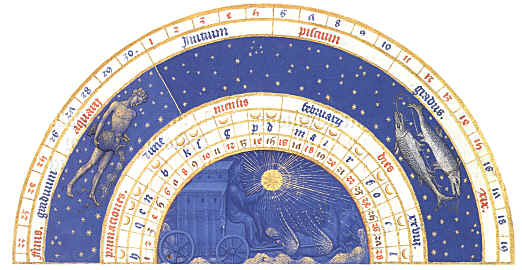
Liturgical calendar for Ravenna, Italy, Milan (?), 1386, illustrated by a follower of Giovannino de’ Grassi, The Morgan Library & Museum, MS M.355, fol. 8v (detail), purchased by Pierpont Morgan, 1909.

The post The Medieval Calendar in Books of Hours appeared first on Medieval Histories.

Powered by WPeMatico
Siberian Cold and Pastoralism in the Early Medieval Alps

When winter came to Italy in the 6th century, people took to the hills and had to find new ways of surviving. This changed their subsistence and diet.

We know it too well in Scandinavia. If the wind blows from the west in December, the winter becomes relatively mild and wet. The winter does not “take”, we say. However, if it blows from the east, the icy and cold air from Siberia seeps into our limbs and souls, holding us in relentless grip until April or even later. Such is the weather patterns in Scandinavia and the rest of Northwestern Europe. In scientific lingo, these observations are to some extent the folksy equivalents of the North Atlantic Oscillation (NAO) patterns, usually summarised in an index used to indicate the atmospheric circulation and weather patterns caused by the difference in atmospheric pressure between the Icelandic low and the Azores high. This index tells us that when it is positive, Europe and the Eastern US have mild and wet weather, whereas Greenland, Northern Canada and Northern Russia get cold and dry. When the opposite is the case, weather in Scandinavia gets cold and dry, while temperatures in Greenland rise. In the Mediterranean, the weather gets wetter. This is excactly what happened in 6th century Europe.

Now, the exciting thing about the NAO is that it can be detected historically by using proxies such as hypolimnic anoxia in lakes, the grow-rings of trees and speleothems, the mineral formations in stalactites, which indicate the amount of precipitation through time. The other quality attached to the NAO is that as an index, it measures general shifts in the weather patterns, as opposed to more local events such as those forced by for instance volcanic eruptions. We might say that the NAO is an index, which gives us a general idea of the large-scale shifts in the weather conditions in Europe in the Middle Ages.

In 2012 a group of scientists published a historical index of the North Atlantic Oscillation from 3.200 BC up until now, based on a geochemical record from a small lake near Kangerlussuaq in Greenland. Recently, this index was used to characterise the correlation between climatic shifts in the Antiquity and the Early Middle Ages and major migratory events.

This study shows that the migratory movement of the Huns c. 375 – 420, which pushed the Goths, the Vandals, the Suebi etc. in front of them, coincided with a negative NAO-cycle, indicating that drought in eastern Europe, as well as central Asia, might indeed have caused a famine, which drove the hoards into western Europe.

Later c. 500 – 600, a corresponding climatic downturn indicates an overall worsening of climate with a cold and arid northern Europe and a corresponding wet and stormy Mediterranean. These climatic turbulences caused the significant Slavic migration into East and Central Europe, perhaps pushing the Lombards into northern Italy.

Without a doubt, these later migratory movements were acerbated by the extreme weather events, which accompanied the volcanic eruptions in c. 536 – 4 and which undoubtedly had significant effects on settlement patterns, social structures, worldviews, and artistic expressions of people on the peripheries of Europe at the end of the migration period.

“Periodic weakening of the NAO caused drought in the regions of origin for tribes in antiquity and may have created a powerful push factor for human migration. While climate change is frequently considered as a threat to sustainability, its role as a conflict amplifier in history may be one of its largest impacts on populations”, writes Lee Drake in a recent review of the Early Medieval North Atlantic Oscillations.

Erosions and Marshes in the Eastern Trentino

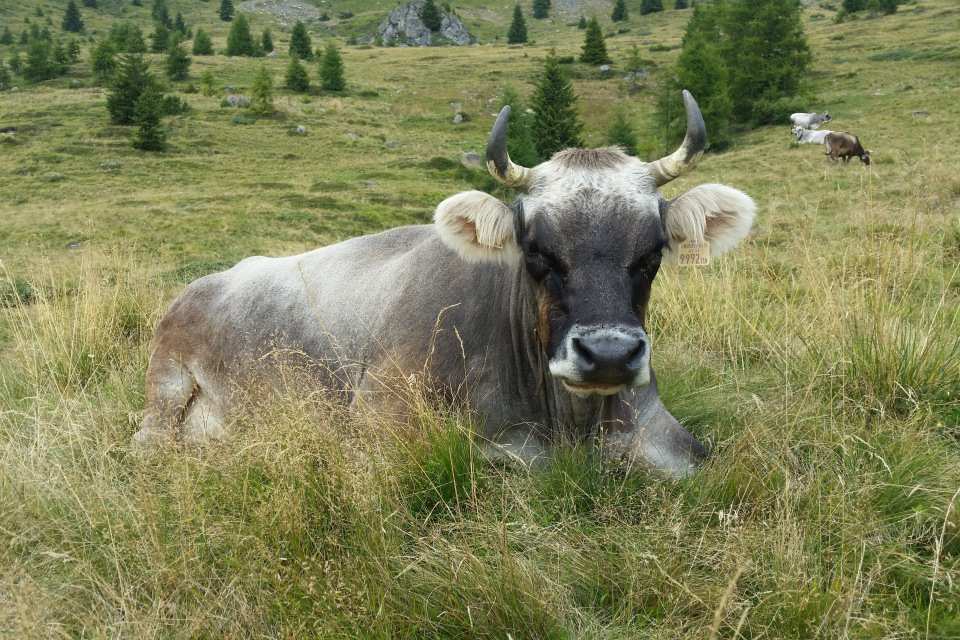
Cattle in the Valsugana Valley © Adopt a Cow

Recently, Paolo Forlin has published a study on how these events played out in at Valsugana in the eastern Trentino in Northern Italy. The Valsugana Valley runs from the east to the west and is bisected by several rivers. To the north runs the Lagorai mountains. Since Augustan times, a major Roman road, the Via Claudia Augusta ab Altino linked the northern Adriatic coast to first Trento and further on through the Adige valley to the Brenner pass. No wonder, people during the Roman optimum settled on the valley floor, which lies a mere 500 metres above the sea.

Archaeological excavations and fieldworks have also documented several Lombardic settlements, or at least the cemeteries featuring furnished graves with grave goods which are characterised as Lombardic (Langobardic). These settlements were located higher up the slopes than the earlier Roman villas. Together with Roman fortresses, these were abandoned due to alluvial erosions and flooding, which left the fertile grounds in the valley marshy, infertile and covered in forests. One such shift to higher ground is demonstrated by the setting of Castel Telvana, within which a Lombardic burial ground was discovered. This settlement was located on a hilltop above the old Roman fortress, Borgo Valsugana, which founded in the 1st century AD as Ausugum, a Roman encampment. Absent from the sources until the 11th century, the place faded from sight until the climate picked up again. As opposed to this, Castel Telvana offered a splendid and safe haven for climatic refugees from the valley-floor as well as the Lombard migrants in the 6th century. This settlement was in all likelihood connected with the Lombard duke, residing in Trento at this time.

Aspart of this move, new and innovative forms of cultivation and other agricultural strategies were adopted. Foremost, a more extensive pastoral economy was developed, so-called wild farming. This sylvo-pastoral economy involved the development of an agricultural regime characterised by more extensive cattle and swine-herding, so-called Alpine transhumance (Alpwirtschaft). This shift can be detected in pollen diagrams, which show a change from dense forests to more open woodlands optimal for grazing herds. Likely, this probably opened up for a more protein-rich diet among the invaders, and a less attractive menu among the dependants and slaves, based on new crops like rye, flax, buckwheat and millet. Bread became scarce, while soups and porridge became daily fare.

FEATURED PHOTO:

Castel Pergine in the Valsugana Valley. Source: Pinterest

SOURCES:

Changes in North Atlantic Oscillation drove Population Migrations and the Collapse of the Western Roman Empire
By Lee Drake
In: Nature: Scientific Reports 7, Article number: 1227 (2017)

The Periphery during the Seventh Century: The Rise of a New Landscape within the Core of the Alps. Climate Change, Land Use and the Arrival of the Lombards in the Eastern Trentino, Northern Italy (sixth to seventh Centuries).
By Paolo Forlin
In: The Long Seventh Century. Continuity and Discontinuity in an Age of Transition. Ed. by Alessandro Gnasso, Emanuele E. Intagliata, Thomas J. MacMaster and bethan N. Morris. Peter Lang 2015, pp. 87 – 106

C4-Consumers in Southern Europe: The Case of Friuli V.G. (NE-Italy) During Early and Central Middle Ages
By P.Iacumin, E.Galli, F.Cavalli, and L.Cecere
In: American Journal of Physical Anthropology (2014) Vol 154, pp. 561 -574

The Floods of 589 and Climate Change at the Beginning of the Middle Ages: An Italian Microhistory
By Paolo Squatriti
In: Speculum (2010) vol. 85, No. 1. pp. 798 – 826

Approaches to the environmental history of Late Antiquity, part II: Climate Change and the End of the Roman Empire.
By: Michael J. Decker
In: History Compass (2017) 15:10,

The post Siberian Cold and Pastoralism in the Early Medieval Alps appeared first on Medieval Histories.

Powered by WPeMatico
Burgundian and Longobardian “Fara”

“Fara” is an enigmatic term. Traditionally meant to designate an Germanic agnatic clan or lineage as well as a band of brothers, the meaning still eludes us.

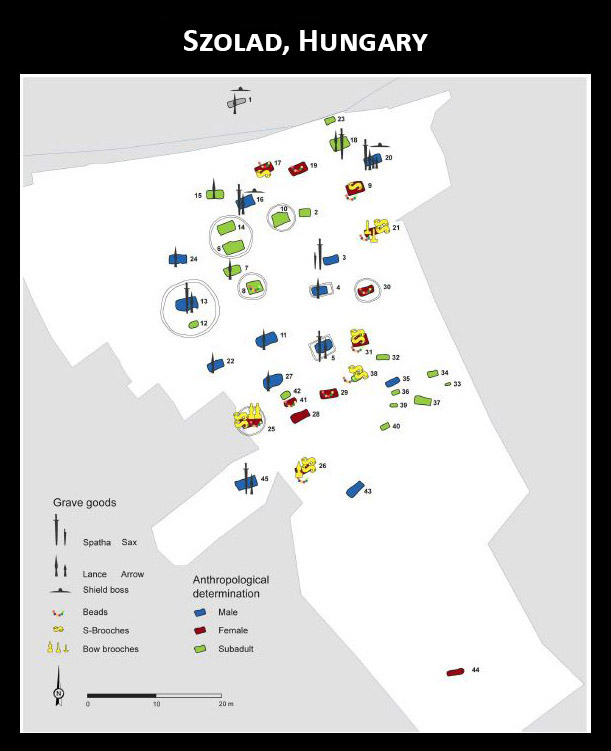
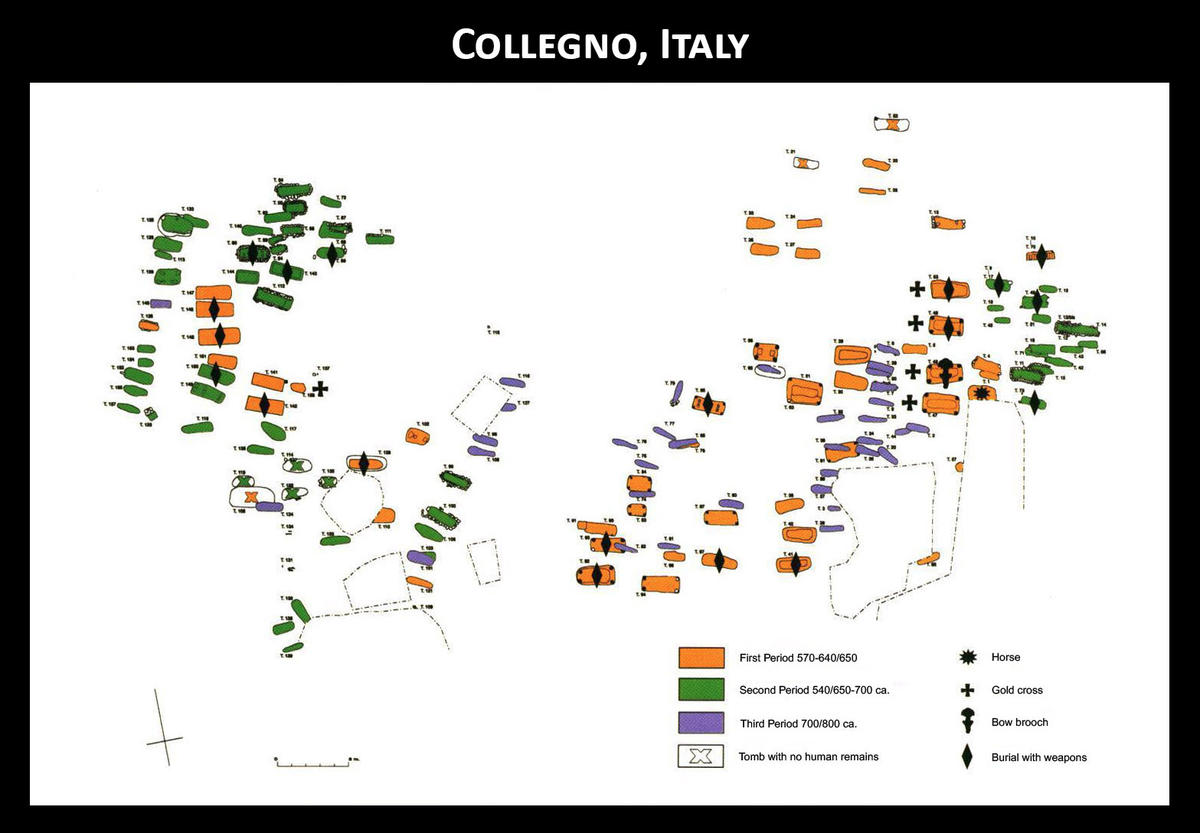
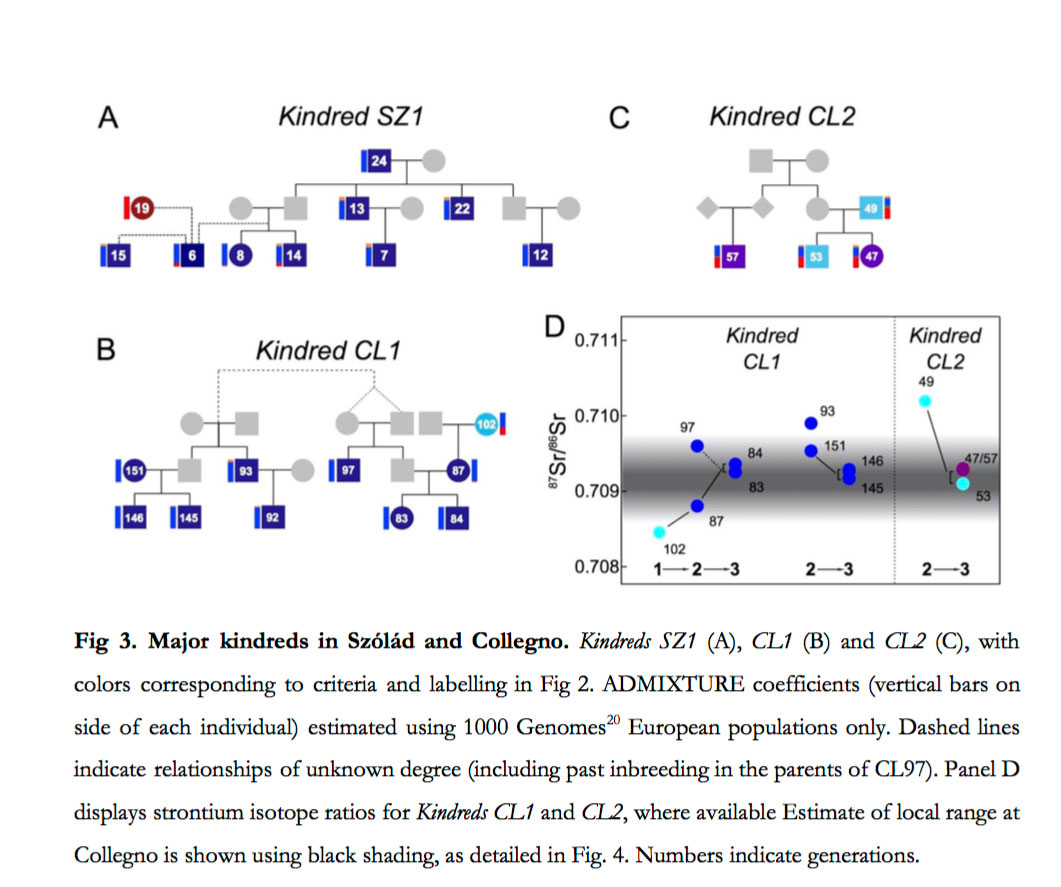
Kindred Grups from Szólád and Collegno  CC BY-NC-ND 4.0
Notice the distinct patrilocal charcater of the two kindreds. Source: Understanding 6th-Century Barbarian Social Organization and Migration through Paleogenomics. Published CC BY-NC-ND 4.0

The verb *faran (Germ) means to move somewhere, to go, to travel, to wander. The noun, *faru means way, going, journey, course, expedition, march, procession; but also – derived from this – as a retinue, companions, followers, troops, comitatus, hird, housecarls, and following this: family, household, livestock, movables. Finally, it may also be understood as proceedings, adventures or even movable possessions.

The verbal noun often appended to another term as in Englandsfari, Jórsalfari etc. means a person, who “fares” to England, Jerusalem etc. In OE (ge)fara means a companion. Later, in Lyon, a “faramanni” would mean a vagabond, viz “en farende mand (svend)” in modern Danish which may have the equivalent meaning.

The first known use of the word can be found in the Burgundian law, Lex Gundobada, c. 500–516. Here we meet the word fara as a prefix to –manni, faramanni. Of these, we learn that they are barbarians (that is non-Romans) and that they are living with or nearby their Roman landlords and that they are encroaching upon the common land, which they by decree are told to share fifty-fifty with their Roman neighbours. The text, however, does not yield us more information as to how we should understand these “faramanni”. Nor does later use of the word in Fourth Book of the Chronicle of Fredegar, where the word, “Burgundaefarones”, crops up as either noblemen or just people belonging to the Burgundian realm or tribe.

The first known use of the expression derives from the writings of Marius von Avenches, who writes c. AD 580 about the events in 569:

Hoc anno Alboenus rex Langobardorum cum omni exercitu relinquens atque incendens Pannoniam suam patriam cum vel mulieribus vel omni populo suo in fara Italiam occupavit; ibique alii morbo, alii fame, nonnulli gladio interemti sunt.

Translation: This year, Alboin, King of the Longobards, [while] leaving and burning all of Pannonia, his fatherland, with all his army, with wives and all his people occupied Italy in “fara”; and there some were killed by illness, some by hunger, and others by the sword.
(Chronicon Marius Aventicensis MGHAA 11).

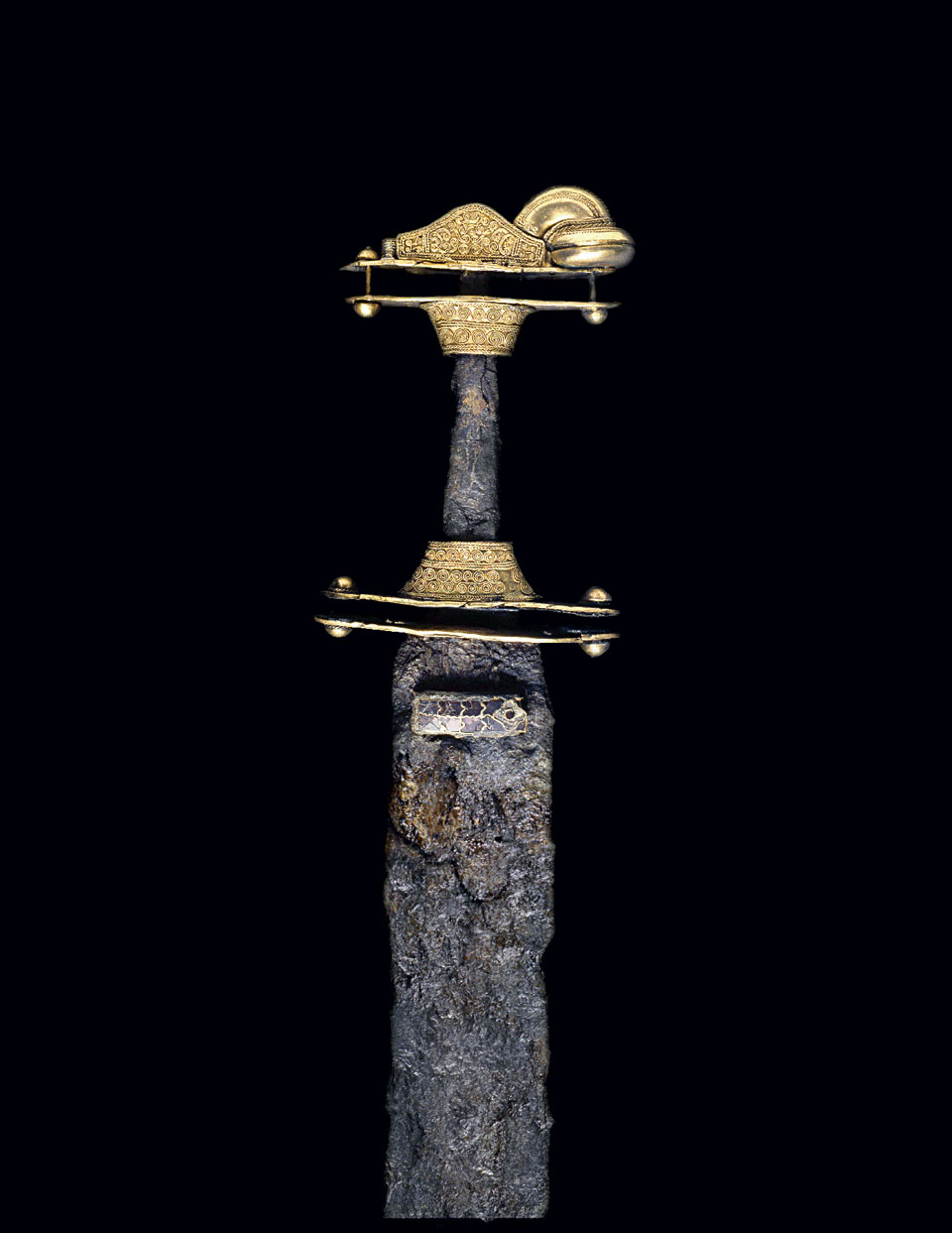
Sword from Nocera Umbra, end of the 6th century ©Museo dell ’Alto Medioevo
Sword from Nocera Umbra, end of the 6th century © Museo dell ’Alto Medioevo

It is evident that those who were killed by disease, hunger or the sword were the Italians, thus ‘fara’ in this contexts should in all probability be understood as “raid”, such as it continued to be understood in a later Norse context (viz, fara i Vikingr)

Another translation, though, of this text might, of course, be that he invaded and occupied Italy with a multitude of people (an army of people); or – derived from this – “fara” might be understood as a “military band”. That is: he occupied Italy, [with a multitude of people] organised in bands (of brothers) together with their wives and descendants. In this case, though, the noun should have been in the plural. The most likely understanding is that Alboin went on a raid or what in Latin is called an expedition (expedition).

This is, however, not the meaning behind the paragraph in Rothair’s edict (§ 177) from AD 643, according to which a Freeman is allowed to move freely together with his “fara” (Si quis liber homo potestatem habeat intra dominium regni nostri cum fara sua migrere ubi voluit”. Here it obviously meant his “household” or perhaps even – as a later gloss has it – just “rebus” (things, viz Glossarium Matritense 20).

Nevertheless, it was later explained as designating kindred or descent-groups by Paulus Diaconus. He wrote:

Igitur, ut diximus, dum Alboin animum intendet, quem in his locis ducem constituere, Gisulfum, ut fertur, suum nepotem, virum per omnia idoneum, qui eidem strator erat, quem lingua propria ‘marpahis’ appellant, Foroiulanae civitati et totae illius regioni praeficere statuit. Qui Gisulfus non prius se regimen eiusdem civitatis et populi suscepturum edixit, nisi ei quas ipse eligere voluisset Langobardorum faras, hoc est generationes vel lineas, tribuere. Factumque est, et annuente sibi rege quas obtaverat praecipuas prosapias, ut cum eo habitarent, accepit. Et ita demum doctoris [ductoris?] honorem adeptus est. Poposcit quoque a rege generosarum equarum greges, et in hoc quoque liberalitate principis exauditus est.” (Hist. Lang. II, 9)

When Albion therefore, as we have said, reflected upon whom he ought to make duke in these places, he determined, as is told, to put over the city of Cividale and over the whole region, his nephew Gisulf, a man most suitable, who was his master of horse—whom they call in their own language “marpahis”. This Gisulf announced that he would not first undertake the government of this city and people unless Alboin would give him [the right] to choose for himself the “faras,” that is, the families or stocks of the Langobards. And this was done, and with the approval of the king, he took to dwell with him the noble houses of the Langobards, which he had desired. And thus finally, he acquired the honour of a leader. He also asked from the king for herds of high-bred mares, and in this also he was heeded by the generosity of his chief.

[Transl. from: History of the Langobards. Historia Langobardorum. By Paul the Deacon. Transl. By William Dudley Foulke. University of Pennsylvania Press 1907).

The explanation offered by Paul the Deacon has been described as asynchronous and retrospective, pasting an 8th-century explanation on a 6th-century phenomenon, namely the establishment of the ducal houses and the Friuli nobility, which came to play such a dominant rule in the next phase. However, he does seem to need to explain the concept, which was thus around, when he wrote his Historia Langbardorum in AD 787–95. His readers – non-Lombards – apparently were in need of an explanation.

This is the same meaning, which may be gathered from topographical descriptions and even Italian toponyms. For instance, we hear about the Castellum Farae Brodoroccae, which is also described as Fara filiorum Bredorochi, that is the fara of the sons of Bredoroch. Another example is the Castrum Tornariciae et Pharam, which elsewhere is called Phara Filiorum Guarnerii, the fara of the sons of Guarnerius, that is the sons of “Warinhari” meaning “defending warrior”.

In the end, fara also came to designate a settlement or village, of which a number may be listed. Of these, at least 35 are mentioned before 1200 in Northern Italy. Most of these seem to be located on the outskirts of less accessible valleys and must be designated as in the geographical periphery.

The Farae of Collegno and Szólád?

Recently, new genetical studies have hinted at the specific social reality behind the word “fara”. At least, this is an intriguing hypothesis. More precisely studies of migratory groups of people found in the late 6th century cemeteries at Szólád in Hungary and Collegno in Northern Italy near Torino have succeeded in sampling aDNA, demonstrating that the groups of people living in these settlements could be divided into distinct kindreds. In both settlements, two distinctive kin-groups consisting of an ancestor, his sons, grandsons and even great-grandsons could be identified. These groups of people were furthermore characterised by better health (more protein in the diet) as well as their more richly furnished graves. A common denominator for the two otherwise distinct kin-groups was their common northern- or central European descent. Also, it could be demonstrated that they or at least the first generation of each of the two kin-groups had taken part in migratory wanderings. These findings are among the first results published by the group Medieval Genetics indicating that it might be possible to identify Germanic agnatic patrilocal clans operating in the Migration Period.

FEATURED PHOTO:

Buckle from Testona Moncalieri near Torino. 6th to 7th centuries. © Torino, Museo di Antichità

SOURCES:

Fara.
By Heinrich Beck, Max Pfister and Reinhard Weskus.
In: Reallexikon der Germanischen Altertumskunde, Vol 8.
De Gruyter, Berlin 1994

Barbarian Europe
Karol Modzelewski
Peter Lang 2015

Germanic Kinship Structure
Murray, A. C.
Toronto 1983

Society and Warfare in Lombardy c. 568 – 652
By: Eduardo Fabbro
A Thesis submitted at the Centre for Medieval Studies, University of Toronto 2015.


The post Burgundian and Longobardian “Fara” appeared first on Medieval Histories.

Powered by WPeMatico
Social Structure among the Longobards in Northern Italy in the 6th and 7th centuries

Studies of ancient DNA on skeletons from two migration period cemeteries in Hungary and Italy tells us in detail about the social structure in the 6th and 7th centuries.

For some time, a group of scientists, archaeologists, and Historians have worked to explore how far studies of aDNA might help us understand the social and political situation in the migration period. More precisely, the group has been studying the composition and living circumstances of two “Longobard” settlements in respectively present-day Hungary and Northern Italy –Szólád and Collegna. Earlier studies have demonstrated that highly mobile groups of people inhabited both settlements. A new study, though, adds to the understanding of the social composition and organisations of these groups of people.

Szólád

Cemetery at Szólád in Hungary from the turn of the 6th century. © Medieval Genetics

The cemetery at Szólád lies on the southern shore of Lake Balaton in the Pannonian Basin in present-day Hungary. Written sources tell us that the Longobards who entered Northern Italy in the 560’s came from here. Studies of the human remains from the 45 graves in the cemetery constitute a first part of the on-going project intended to follow in the footsteps of people in the migration period to gain a better understanding of how the events in the 6th and 7th centuries played out.

In the first wave of DNA-studies focus was on the mitochondrial DNA. These studies, as well as Isotopic analyses, showed that the settlers presented themselves as a highly mixed group of which at least 31% died in another location than that in which they grew up. Initially, a patrilocal group settled at Szólad accompanied by a group of females deriving from a wider geographical context. Soon after, though, people moved on. The patriarchal character of the society was revealed by the fact that the males obviously had enjoyed a protein-full diet; as opposed to that of the women. “The inferred dynamics of the burial community are in agreement with hypotheses of a highly mobile lifestyle during the Migration Period and a short-term occupation of Pannonia by Lombard settlers as conveyed by written sources”, wrote the authors of the first study.

Recently, these findings have been supplemented with more deep genomic characterisation, showing that the people at Szólád could be divided into four distinct kindred-groups. The first one consisted of an alfa-male with his male children and grandchildren. All in all, descendants of four sons could be detected. Two of these sons were buried at Szólád, which also held five male grandchildren and one female descendant. These people were all buried in furnished graves, of which six were weapon-graves. One person was buried with a horse and weighing-scales. These male graves were surrounded by a smaller group of women. Unfortunately, not all of these women could be sampled. Hence, the exact relationship between these females and the youngsters buried among their male kindred could not be determined. The cemetery also held three other, yet smaller kindred-groups, typically buried with less or no stuff. Comparison of the DNA-profile of the central group of males showed its affinity to Finnish, as well as Central, Northern and Anglo-Saxon Europeans. The others carried a gene pool from southern Europe

Collegno

Cemetery at Collegno from the 6th and 7th century © Medieval Genetics

These studies of the people from Szólád have led to a comparison with material from another location, more precisely the remains of 57 people buried at Collegno west of Turin in Northern Italy. This cemetery held graves which could be dated between AD 580–630, based on the typologies of the artefacts found in the burials. These artefacts are similar to the types found at Szólád.

People in this cemetery at Collegno could also be divided into distinct kindred-groups, in this case, three. One of these was more prominent than the others. Albeit these people were buried in well-furnished graves as in Szólád, they were nevertheless found at Collegno to occupy spatially distinct graves. Similar to Szólád, though, this kindred also seems to derive from elsewhere. Again males seemed to derive from a northern or central European context, while females were related to a wider French or Swiss background. Also, the scientists found that the dominant kindred had profited by a diet containing more protein than its neighbours with apparent Italian ancestry.

The conclusion is that as at Szólad, Collegno was at some point “invaded” by a group of people, whose ancestors derived from a northern or central European context. While the cemetery at Szólad, however, held the burial of a primary ancestor with his descendants (three generations), the group at Collegno consisted of only two closely related generations of 2(4) grandsons plus grandchildren (with two grandsons not identified among the buried at Collegno). At Collegno, these “invaders” came to live among an already settled population of Italian descent. This conclusion is supported by the analysis of strontium, which showed that while the settlers at Szólád all seemed to come from elsewhere, this was only the case for the first generation of the dominant kindred or descent group at Collegno.

Conclusion

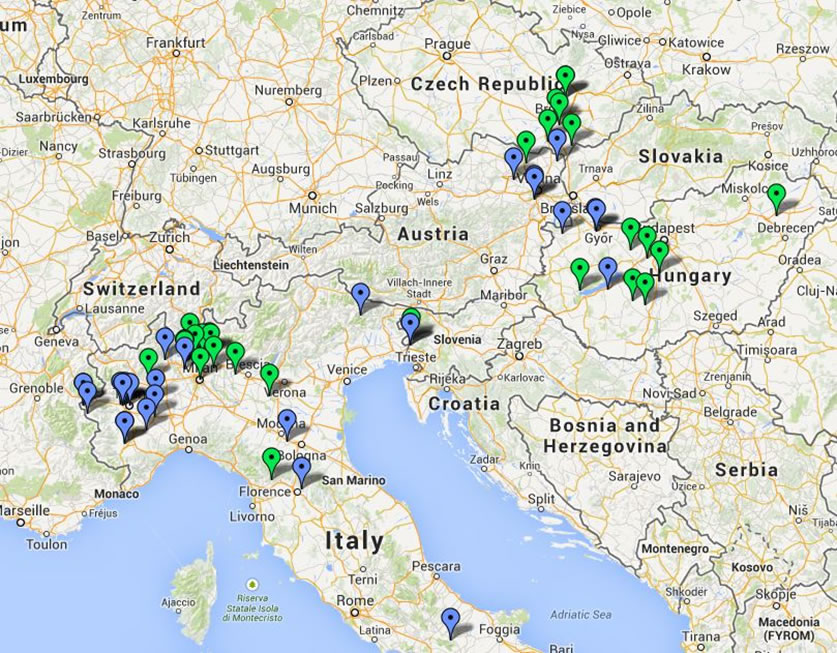
Map of designated migration period cemeteries investigated by Geahry et al
Medieval genetics. A group led by Patrick Geary is currently sampling graves from 56 cemeteries © Medieval Genetics

As is proper, the authors of this new study are careful not to press the material too much. It might be tempting to identify the two dominant kindred-groups straight away with “Longobardian” migrants with an original northern European ancestry and defined by a specific material culture and burial practice. These examples of well-armed patrilocal descent-groups may even be understood as representatives of the ‘Fara’, the famous “bands of brothers” thought of as the predominant social element of the Barbarian armies. But this is much too crude, they claim. What might perhaps at this point be concluded is the existence of at least two cases where extended migrant kindreds arrived from the outside to settle as close-knit patrilocal descent groups and also, that they may perhaps be characterised by their homogenous material culture and burial practices. “Thus our results cannot reject the migration, its route, and settlement of the “Longobards” as described in the historical texts, they write. Adding, that “since the adults were almost all non-locals, it is [also] tempting to suggest that we may be observing the historically described fara during migration.” The study, thus, throws a flame into the simmering controversy between the social constructivists of the “ethnogenesis” school of Vienna, and the ongoing reinvention of the traditional linking of ethnicity and culture. Hence, the somewhat conjectural account.

Whatever position, we take in this on-going battle, we must, nevertheless, all agree that this study offers us much upon which to reflect. Not least, the recommendation to carry out similar studies of other migration period cemeteries that we may gain a better understanding of the social dynamics and types of social organisation which characterised the settlements behind. Fortunately such studies are in the pipeline.

FEATURED PHOTO:

Elongated Skull from Collegno 6th century. Another characteristic element of the buried at Collegno was the tradition to wrap and elongate skulls. Unfortunately, the published material does not tell us which kindred at Collegno this skull belonged to. Source: Wikipedia

SOURCE:

Understanding 6th-Century Barbarian Social Organization and Migration through Paleogenomics
By Carlos Eduardo G Amorim, Stefania Vai, Cosimo Posth, Alessandra Modi, István Koncz, Susanne Hakenbeck, Maria Cristina La Rocca, Balazs Mende, Dean Bobo, Walter Pohl, Luisella Pejrani Baricco, Elena Bedini, Paolo Francalacci, Caterina Giostra, Tivadar Vida, Daniel Winger, Uta von Freeden, Silvia Ghirotto, Martina Lari, Guido Barbujani, Johannes Krause, David Caramelli, Patrick J Geary, Krishna R Veeramah
The article is published as a preprint on bioRxiv – The Preprint Server for Biology on 20.02.2018. https://doi.org/10.1101/268250

READ MORE:

Medieval Genetics. Population Mobility in the Early Middle Ages through Genomic Research

Under the direction of Professor Patrick Geary of the Institute for Advanced Study, a team of archaeologists, geneticists, and historians are undertaking genomic analysis of some 1400 individuals found in cemeteries in the Czech Republic, Hungary, Austria, and Italy in the sixth century.

READ ALSO:

Migration Period People on the move

Burgundian and Longobardian “Fara”


The post Social Structure among the Longobards in Northern Italy in the 6th and 7th centuries appeared first on Medieval Histories.

Powered by WPeMatico