The Royal Complex of Scone from the 10th century

Scone is best known for the Stone of Scone, also known as the Stone of Destiny or the Stone of Coronation. Less well known is that Scone was the primary ceremonial and legislative gathering place in Scotland. Recently, the results from extensive archaeological excavations were published.

The Stone of Scone is an oblong, red sandstone used as the Scottish coronation stone. Famously taken by Edward I of as part of the spoils of war and taken to Westminster. Although, the English promised to return the stone in 1328, it remained in England until 1950, when it was “stolen” from The Abbey and brought back to Scotland. Retrieved by the British Authorities, it was not until 1996 that the stone was formally returned to Scotland as a gesture of conciliation. It now resides at the castle in Edinburgh until the next British coronation. Whether or not this Stone of Scone is the original has been disputed for centuries. More interesting though, it seems, is to investigate the original setting of the stone at the centre of the ancient ceremonial assembly ground at Scone and compare the site with other similar assembly grounds.

The Royal Complex at Scone

The Stone of Scone. Source: Wikipedia

Scone’s role as the premier site for royal investiture and legislative assemblies is well known. The earliest trusted record dates to AD 906, while the last state occasion took place in 1651.

At the centre of the complex is the Moothill Mound, the site of an Augustinian Abbey founded by Alexander I in c. 1120. The mound measures 90 x 64 metres and rises two metres above ground. It is located inside the Abbey grounds with the ruined church to the south. This measured c. 77 metres and was impressive enough to be used for the actual medieval unction and coronation ceremonies of kings and queens.

Moothill, itself, was ditched. Radiocarbon dates from charcoal fragments found in the ditch dates the site to the 10thto 12thcenturies, thus generally confirming the written evidence, from the Chronicle of the Kings of Alba’ (dated to the 10thcentury.) As excavations in the mound itself has not been carried out the exact date cannot be fixed, but the possibility exists that the written record and the construction of the mound and the ditch surrounding it can be dated to c. AD 1000. “Whether in the tenth or eleventh century, the creation and augmentation of a monumental platform for high ceremonial and legislative assemblies was implicated in elite political strategies to elevate Scone as a royal centre”, writes O’Grady, who continues to describe how the place was used for legislative assemblies until the 15thcentury, when they were moved to more secure locations in the royal strongholds of Perth, Stirling, and Edinburgh.

The European Context

After the foundation of the Abbey in the 12thcentury, the meeting ground at Scone came to look much like the traditional idea of an “Aula Regia”, a space consisting of a royal chapel, a space dedicated to processions, and a proper meeting ground – whether inside a hall or outside on a mound. The O’Grady mentions similar places at Cordoba, Aachen, Westminster, Prague, Gamla Uppsala, Nidaros in Norway and Lund in Sweden. Others worthwhile exploring in detail would be Paderborn, the Saxon twin of Aachen, the somewhat later Goslar, and Jelling, with the last two dated to approximately to the same timeframe as the complex at Scone (the 10thand early 11thcentury).

Whether or not a church was erected at Scone at the beginning of the 10thcentury cannot be known without further excavations. It seems likely, though, that familiarity with the model as it derived from Trier via Aachen, was widespread in the 10thcentury and onwards, and that it likely inspired the construction of the assembly site at Scone.

SOURCE:

Accumulating Kingship: the archaeology of elite assembly in medieval Scotland
By Oliver J. T. O’Grady
In: World Archaeology
Published online: 12 Jul 2018

ABOUT THE AUTHOR:

Oliver J. T. O’Grady is a landscape archaeologist with expertise in the archaeology and history of medieval north-west Europe. His research focuses are the interdisciplinary study of medieval landscapes and elite central places, the material remains of medieval gathering practices and the political role of the medieval Church. His PhD was entitled ‘The Setting and Practice of Open-air Judicial Assemblies in Medieval Scotland’, which led to his role as Principal Investigator of field investigation projects at the royal centre and medieval inauguration site at Scone in Perthshire, Scotland (2005–2011). He currently works as a freelance independent researcher and archaeologist.

READ MORE:

He has worked in connection with the project: Debating the Thing in the North: the Assembly Project.


The post The Royal Complex of Scone from the 10th century appeared first on Medieval Histories.

Powered by WPeMatico

Scone is best known for the Stone of Scone, also known as the Stone of Destiny or the Stone of Coronation. Less well known is that Scone was the primary ceremonial and legislative gathering place in Scotland. Recently, the results from extensive archaeological excavations were published.

The Stone of Scone is an oblong, red sandstone used as the Scottish coronation stone. Famously taken by Edward I of as part of the spoils of war and taken to Westminster. Although, the English promised to return the stone in 1328, it remained in England until 1950, when it was “stolen” from The Abbey and brought back to Scotland. Retrieved by the British Authorities, it was not until 1996 that the stone was formally returned to Scotland as a gesture of conciliation. It now resides at the castle in Edinburgh until the next British coronation. Whether or not this Stone of Scone is the original has been disputed for centuries. More interesting though, it seems, is to investigate the original setting of the stone at the centre of the ancient ceremonial assembly ground at Scone and compare the site with other similar assembly grounds.

The Royal Complex at Scone

The Stone of Scone. Source: Wikipedia

Scone’s role as the premier site for royal investiture and legislative assemblies is well known. The earliest trusted record dates to AD 906, while the last state occasion took place in 1651.

At the centre of the complex is the Moothill Mound, the site of an Augustinian Abbey founded by Alexander I in c. 1120. The mound measures 90 x 64 metres and rises two metres above ground. It is located inside the Abbey grounds with the ruined church to the south. This measured c. 77 metres and was impressive enough to be used for the actual medieval unction and coronation ceremonies of kings and queens.

Moothill, itself, was ditched. Radiocarbon dates from charcoal fragments found in the ditch dates the site to the 10thto 12thcenturies, thus generally confirming the written evidence, from the Chronicle of the Kings of Alba’ (dated to the 10thcentury.) As excavations in the mound itself has not been carried out the exact date cannot be fixed, but the possibility exists that the written record and the construction of the mound and the ditch surrounding it can be dated to c. AD 1000. “Whether in the tenth or eleventh century, the creation and augmentation of a monumental platform for high ceremonial and legislative assemblies was implicated in elite political strategies to elevate Scone as a royal centre”, writes O’Grady, who continues to describe how the place was used for legislative assemblies until the 15thcentury, when they were moved to more secure locations in the royal strongholds of Perth, Stirling, and Edinburgh.

The European Context

After the foundation of the Abbey in the 12thcentury, the meeting ground at Scone came to look much like the traditional idea of an “Aula Regia”, a space consisting of a royal chapel, a space dedicated to processions, and a proper meeting ground – whether inside a hall or outside on a mound. The O’Grady mentions similar places at Cordoba, Aachen, Westminster, Prague, Gamla Uppsala, Nidaros in Norway and Lund in Sweden. Others worthwhile exploring in detail would be Paderborn, the Saxon twin of Aachen, the somewhat later Goslar, and Jelling, with the last two dated to approximately to the same timeframe as the complex at Scone (the 10thand early 11thcentury).

Whether or not a church was erected at Scone at the beginning of the 10thcentury cannot be known without further excavations. It seems likely, though, that familiarity with the model as it derived from Trier via Aachen, was widespread in the 10thcentury and onwards, and that it likely inspired the construction of the assembly site at Scone.

SOURCE:

Accumulating Kingship: the archaeology of elite assembly in medieval Scotland
By Oliver J. T. O’Grady
In: World Archaeology
Published online: 12 Jul 2018

ABOUT THE AUTHOR:

Oliver J. T. O’Grady is a landscape archaeologist with expertise in the archaeology and history of medieval north-west Europe. His research focuses are the interdisciplinary study of medieval landscapes and elite central places, the material remains of medieval gathering practices and the political role of the medieval Church. His PhD was entitled ‘The Setting and Practice of Open-air Judicial Assemblies in Medieval Scotland’, which led to his role as Principal Investigator of field investigation projects at the royal centre and medieval inauguration site at Scone in Perthshire, Scotland (2005–2011). He currently works as a freelance independent researcher and archaeologist.

READ MORE:

He has worked in connection with the project: Debating the Thing in the North: the Assembly Project.


The post appeared first on Medieval Histories.

Powered by WPeMatico
Genetic Perspective on the Bavarians from the Migration period

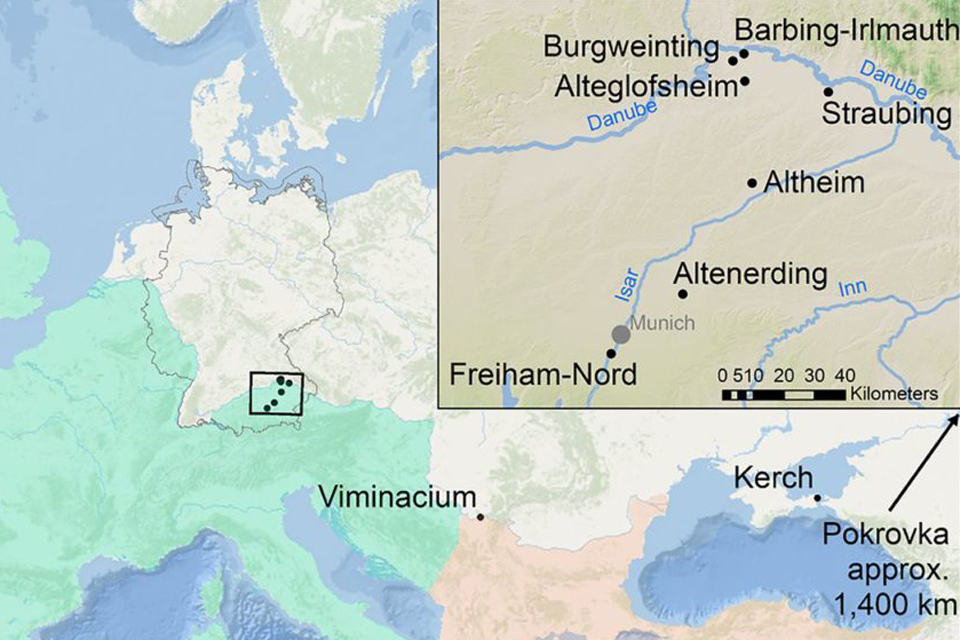
Recently the human remains from 41 graves from six early medieval cemeteries in Southern Bavaria yielded genomic data showing that while men generally had ancestry resembling northern or central Europeans, the women exhibited a very high genetic heterogeneity.


Map of southern Bavarian burial grounds from the Early Middle Ages with geographic indication of migration of females with elongated skulls. Source: Pinterest
Map of southern Bavarian burial grounds from the Early Middle Ages with geographic indication of migration of females with elongated skulls. Source: Anton Doll.

The early medieval burial grounds around Altenerding are justly famous for their plague victims, whose aDNA revealed the genetic imprint of the Justinian Plague as being of the same kind as the Black Death. The archaeological excavations have uncovered a multitude of detailed information about their daily life as well as burial customs. Now recent studies of their aDNA have added to this profile helping us to know about the ancestry of these people and the complex demographic processes, which made up the populace of some of the migratory movements of the 5thand 6thcentury.

The first mention of the Baiuvarii – present-day Bavarians – is credited to the historian Jordanes, who wrote about them in his book Getica in 551. Settled in the present-day upper and lower Bavaria, it has traditionally been argued that these Baiuvarii were composed of a mixture of the resident provincial Roman population plus immigrants from north-eastern Bavaria and Bohemia as well as their descendants (p. 151).

The new studies of the aDNA of some of these people show that the picture is much more complex.

First of all the study of the genomic data documents that people – apart from two females from Greek or Anatolian descent – predominantly exhibited a northern or central European ancestry, more precisely located in present-day northern France, the Netherlands, and Northern Germany. No traces were found of southwestern European DNA. Thus the authors conclude that the genetic profile of the population argue against any kind of significant admixture between the local migrants from the north and the Roman militia.

Further, one of the features of some of the skeletons in the five locations studied, is their elongated skulls, artificially created during early childhood. In the Bavarian sample these skulls belonged exclusively to females and could be detected in 14 individuals.

The genetics analysis showed that the individuals with these skulls presented an admixture of genetic ancestry found in southern to southeastern European countries. One woman even showed East-Asian ancestry

One of the most striking results of this study is the genetic difference between Early Medieval individuals with or without elongated skull, writes the group of scientists. While both females and males without this artificially induced deformity exhibited a common ancestry of northwestern and central European descent, the females with elongated skulls were genetically much more diverse. It thus looks as if local Bavarians did not artificially deform the heads of their children as has been suggested elsewhere. Such females likely migrated from southeastern Europe, witnessing to a system of exogamic exchanges of females between Baiuvarii and the steppe people (the Huns, Samatians and Avars). However the study suggests that this explanation does not cover the genetic findings.

These females, however, were obviously integrated into the local communities as their assemblies of grave goods showed a cultural mixture of both worlds. “This not only indicates a potentially significant level of integration of these women, but also cautions against inferring migration from material culture”, they write. (p. 3497)

The authors conclude that the genomic analysis of the type carried out on the 41 individuals in this sample, demonstrate the need for more micro-analyses of the same type. Such studies are essential to “better understand the complex patterns of migration, admixture, population structure, growth, and selection during more recent times”, they write.

FEATURED PHOTO:

Females buried at Altenerding with elongated skulls. © State collection for Anthropology and Paleoanatomy Munich, Germany

NOTES:

The Baiuvarii and Thuringi: An Ethnographic Perspective
Ed. by Janine Fries-Knoblach, Heiko Steuer and John Hines
Boydell & Brewer 2014, p. 151)


SOURCE:

Population genomic analysis of elongated skulls reveals extensive female-biased immigration in Early Medieval Bavaria
By Krishna R. Veeramah, Andreas Rott, Melanie Groß, Lucy van Dorp, Saioa López, Karola Kirsanow, Christian Sell, Jens Blöcher, Daniel Wegmann, Vivian Link, Zuzana Hofmanová, Joris Peters, Bernd Trautmann, Anja Gairhos, Jochen Haberstroh, Bernd Päffgen, Garrett Hellenthal, Brigitte Haas-Gebhard, Michaela Harbeck, and Joachim Burger. Edited by Eske Willerslev, University of Copenhagen, Copenhagen, Denmark, and approved January 30, 2018 (received for review November 21, 2017)
IN: PNAS March 27, 2018. 115 (13) 3494-3499; published ahead of print March 12, 2018.

READ MORE:

Altenerding in Oberbayern. Struktur des frühmittelalterlichen Gräberfeldes und Ethnogenese der Bajuwaren.
Ed. by Hans Losert and Andrej Pleterski
Berlin, Bamberg, Ljubljana 2003

The post Genetic Perspective on the Bavarians from the Migration period appeared first on Medieval Histories.

Powered by WPeMatico

The Genetics of Longobard-Era Migrations

For some time an international and interdisciplinary group of archaeologists, scientists, and historians have worked to uncover the minutiae of the Longobard invasion of Italy in AD 568. Genetic explorations are shedding extremely important new light on the linkage between genetics and cultural profiles.

According to the historian Paul the Deacon, the Longobards, who entered Italy in 568, originally came from Scandinavia via present-day Hungary and Czekia. Traditionally they have been identified through their jewellery and weapons as well as the tradition of burying their dead in furnished graves.

In the latter part of the 20thcentury, questions were raised as to the extent objects might be identified as markers for ethnic identity. These questions were part of avery  contentious debate as to the magnitude of the migratory movement of people in the 4thto 6thcenturies, the so-called migration period.

Was it just small groups of Germanic mercenaries, who migrated? Did women participate in the migrations or were they “sourced” among the local populace? Did the distinct jewels, weapons and burial practices reflect inventions of traditions following the upheavals in Late Antiquity? Rather than a cultural diffusion from Germania Magna into the Western Roman Empire?

One way of answering these questions is of course to try and characterise the genetic make-up of people from different kinds of burials in order to identify their genetic heritage and then par it with their cultural profile.

Recently the researchers behind the project “Lombards on the Move”  – reported some new results. By studying the mitochondrial sequences of 87 individuals from nine early-medieval cemeteries along the route believed to have been used by the migrating Longobards in the mid-6thcentury, and linking the results with the cultural profiles of their burials, they have come up with some fascinating results.

The mains results are that there was a 70% degree of genetic continuity between individuals buried with what is believed to be traditional Longobard cultural markers reaching from Hungary to Northwestern Italy. Also, regarding twelve individuals, it was possible to discern a mitochondrial profile found in high frequencies in northern Europe, e. g. Finland. Eight of these twelve persons were buried with what has hitherto been regarded as typical Longobard artefacts. But the study also showed that a definite genetic admixture had taken place – either at an earlier time or during the migration period. To conclude: there did exist a certain likage between genetics and material culture. But the identification is not 100%.

In their conclusion, the authors write that “this supports the idea that the spread of Longobards into Italy actually involved movements of a fairly large number of people, who gave a substantial contribution to the gene pool of the resulting populations.” This is even more remarkable as the mitochondrial element of a genetic profile is inherited though mothers, which means that the migratory movement cannot have consisted only of male militia. Women must to some extent have accompanied them, or their offspring in the new locality would have lost its original genetic imprint.

SOURCE:

A Genetic Perspective on Longobard-Era migrations
By Stefania Vai, Andrea Brunelli, Alessandra Modi, Francesca Tassi, Chiara Vergata, Elena Pilli, Martina Lari, Roberta Rosa Susca, Caterina Giostra, Luisella Pejrani Baricco, Elena Bedini, Istvan Koncz, Tivadar Vidar, Balazs Gusztav Mende, Daniel Winger, Zuzana Loskotova, Krishna Veeramah, Patrick Geary, Guido Barbujani, David Caramelli, Silvia Ghirotto
The article has been generously shared on bioRxiv – The Preprint Server for Biology. (And has not yet been peer-reviewed).

READ ALSO:

Migration, integration and cultural consolidation are the new buzzwords in archaeology

Social Structure among the Longobards in Northern Italy in the 6th and 7th centuries

Burgundian and Longobardian “Fara”

The post The Genetics of Longobard-Era Migrations appeared first on Medieval Histories.

Powered by WPeMatico