The Winegrowing Region of Saale-Unstrut in the Middle Ages

Numerous small springs and other water sources feed the rivers Saale and Unstrut before they confluence with the Elbe. Along these river valleys, the hilly countryside is still fit for winegrowing while the fertile flat land along the rivers offers excellent agricultural possibilities.

The Saale-Unstrut region lies in between the confluence of the rivers Saale and Unstrut in a hilly and steep countryside with a thousand-year-old tradition for winegrowing. This made it until recently, the northern-most winegrowing region in Germany.
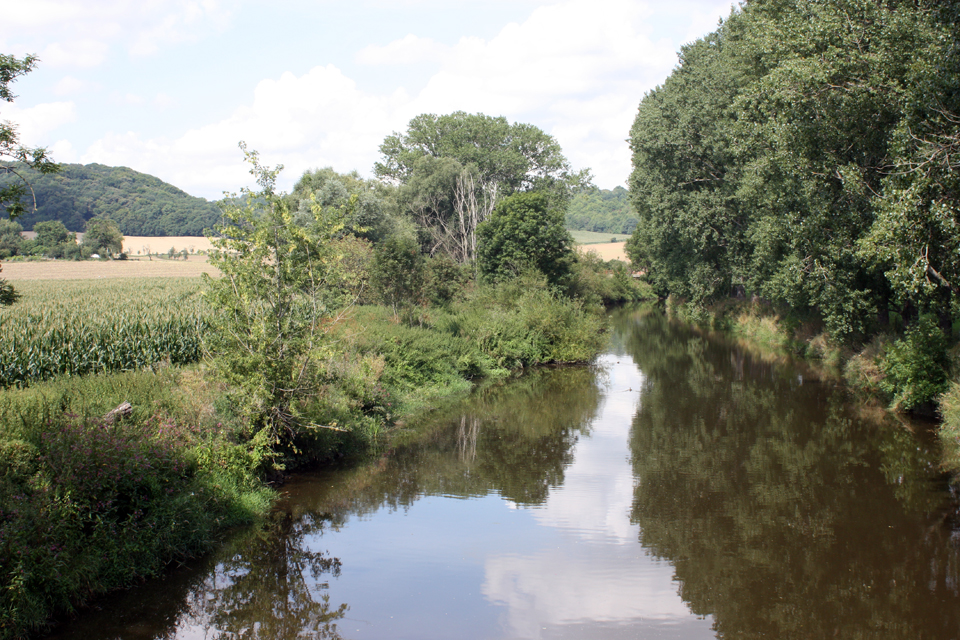
The River Unstrut near the village of Burgscheidungen. Source: Wikipedia/Dgunendel
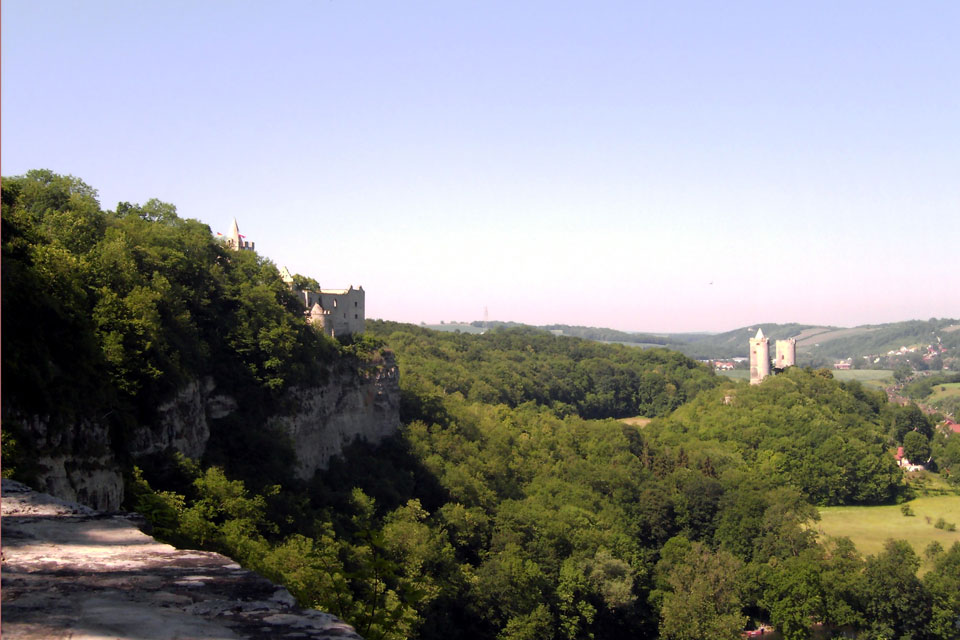
Rudelsberg und saaleck in the Saale-Unstrut Region. Source: Wikipedia
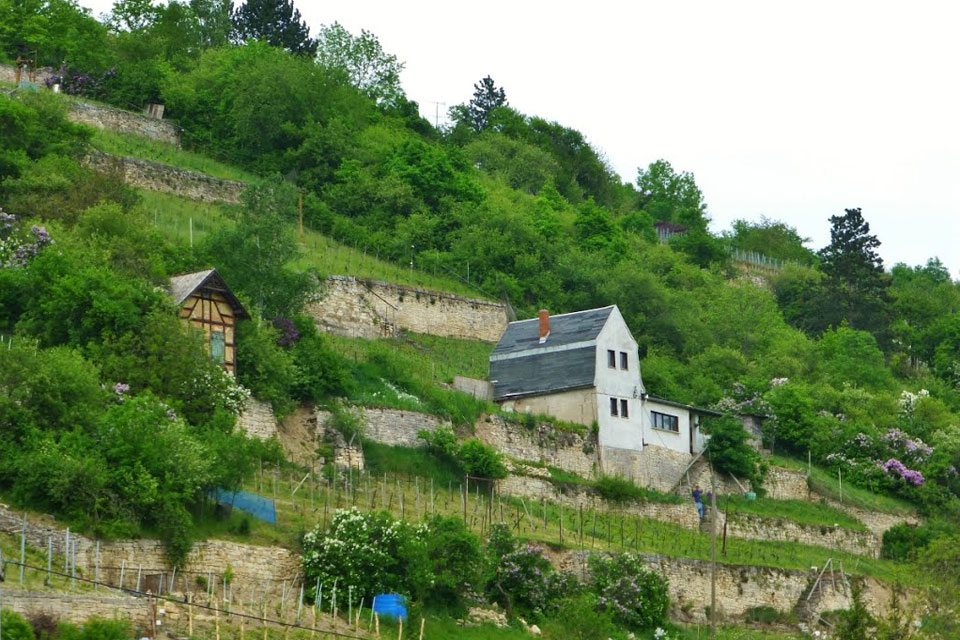
Schweigenberg near Freyburg. Source: Wikipedia

Vineyards

Though it is believed wine was grown from the 7th century, the earliest exploitation of the steep hillsides for viticulture is documented for the 10thcentury. More precisely, a donation from )98 to the monastery in Memleben lists seven locations where vineyards were cultivated. Unfortunately, the hillsides with their terraces are not workable with heavy machinery, and in recent years the landscape is marred by abandoned vineyards and loss of biodiversity. Also, the traditional dry walls bordering the terraces have been left crumbling.

Although some sites – e. g. the Kathert Vineyard in Karsdorf – have been preserved as part of the regions cultural heritage, much has been lost. The traditional wine cabins, which housed the vineyard guards when the grapes were ripe, have also been lost.

Castles and Monasteries

Another natural feature, the abundant limestones and red sandstone provided building material for the Romanesque architecture, which continue to plays such a visible role in the landscape of the region.

SOURCE:

The Saale-Unstrut cultural landscape corridor
By M. Hoppert, B. Bahn, E. Bergmeier, M. Deutsch, K. Epperlein, C. Hallmann, A. Müller, T. V. Platz, T. Reeh, H. Stück, W. Wedekind. Siegesmund
In: Environmental Earth Sciences, February 2018, 77:58

READ MORE:

Natur Stein Kultur Wein: Zwischen Saale und Unstrut
By Siegfried Siegesmund Michael Hoppert and Klaus Epperlein (Ed).
Mitteldeutscher Verlag 2014


The post The Winegrowing Region of Saale-Unstrut in the Middle Ages appeared first on Medieval Histories.

Powered by WPeMatico

No more Icelandic or Old Norse at University of Copenhagen

From 2019, the University of Copenhagen will no longer offer courses for students in Old Danish, Norse, modern Icelandic, and Faroese. The reason is that the elective courses in Norse, as well as the other languages, have not been able to muster the required minimum of 30 students, set as a standard by the Chancellors office.

For 2019, the University of Copenhagen has been required by the Danish Government to cut the budget with 160 mills. DKR. Apart from weeding small subjects from the curriculum – like e.g. art- and cultural history – this has led to a general requirement: courses offered has to be able to muster at least 30 students. Recently, it was revealed that the University would no longer offer courses in such old and venerated subjects as Norse, Modern Icelandic, Faroese, and Old Danish. As numerous scholars have pointed out, this will be the end of not only a golden era but also endanger recruitment of the necessary “nerds” to people such venerable institutions as The Arnamagnæan Institute in the future. The Arnamagnæan holds the largest collection of old Icelandic manuscripts outside of Iceland and has been at the centre of Norse research since the 18thcentury. The Arnamagnæan Institute’s chief function is to preserve and further the study of the manuscripts in the Arnamagnæan collection, in accordance with the terms of the Arnamagnæan Foundation, established in 1760. The collection, which comprises some 3000 items, is now divided between Copenhagen and Reykjavík. In 2009 the collection was added to UNESCO’s Memory of the World Register in recognition of its historical value.

Also, future recruitment to large projects like “The Danish Dictionary” and its subsidiaries like “Gammeldansk Ordbog“ (Old Danish Dictionary) is threatened.

It may be a tactical manoeuvre. Already, the Associate Dean, Jens Erik Mogensen, has been hinting at the possibility that the courses will be re-established if government funding can be found.

– I will fight to get a grant for the small language subjects, which will not otherwise be financially feasible, says the Jens-Erik Mogensen to the University Paper, adding that: – Many of them are actually research subjects, where it does not make sense to talk about a wider labour market or a large number of student admissions, so they are different.

At the strategic level, it is nevertheless, quite tasteless. The subjects not only belong to a group of smaller languages, which have been threatened for years. They represent a vastly significant immaterial heritage of not only national Danish and Scandinavian value, but also with a recognised global standing. We live at a time when media corporations produce global series (e.g. Vikings) and games (e.g. Hellblade), which resonate among countless youngsters, while people, in general, participate in cultural tourism exploring the many sites of “Viking” importance. Who is going to help these people to a better and more fulfilling experience, when no one can any longer read the sagas, the laws and the poetry, which are the texts offering the context for historians and archaeologists, and more amateurish re-enactors?

The University of Copenhagen full well knows that the government is bound to step up. The political landscape offers no backdoor.

Thus, the formulated plans reveal nothing but a feeble will to save at least some of the threatened subjects, currently under review. Others will not be as lucky. Nor will the students, who will never experience the joy of studying at a university, because it has been reduced to a factory with no less than at a minimum 30 students in classes. No tutoring in small groups. On the other hand: for a long time it has been uphill to teach students that “studying at a university” is not the same as “going to school”!

SOURCE

Det er slut med at læse dansk på KU.
By Nanna Balslev
In: Uniavisen 24.05.2018

The post No more Icelandic or Old Norse at University of Copenhagen appeared first on Medieval Histories.

Powered by WPeMatico