A Long Tale to Tell: Crime and Imprisonment in the United States

by Tony Platt

In the United States, there is a long history of police violence and failed attempts to counteract it. Beyond These Walls offers a far-ranging exploration that tracks the legacy of crime and imprisonment, from the historical roots of the American criminal justice system to our modern state of over-incarceration, and offers a bold vision for a new future. Author Tony Platt, a recognized authority in the field of criminal justice, challenges the way we think about how and why millions of people are tracked, arrested, incarcerated, cataloged, and regulated in the United States. Keep reading for an exclusive essay from the author.

* * * * *

Police killings of civilians are so commonplace that it now requires an unusual circumstance for social media and journalists to take note. The death of Emantic Fitzgerald Bradford Jr. was newsworthy in November because police in Hoover, Alabama, mistook this African American man for a dangerous criminal when in fact he was trying to Thanksgiving shoppers from a shooter.

Bradford was one of three people killed by the police that day. The other two were not so newsworthy.
In 2014 and during the presidential campaign, activists compelled the media to resurrect many of the dead victims of police violence as full human beings, their deaths recorded on YouTube and debated at political conventions.

We learned their names and about their lives: Freddie Gray, Jr. killed as a result of spinal injuries suffered from a “rough ride” in a Baltimore police van; Eric Garner arrested for selling “loosies” and choked to death by police in New York; Michael Brown Jr., shot by police in Ferguson, his body left for hours in a public place in the sweltering Midwest heat; twelve-year-old Tamir Rice, shot to death by Cleveland police who claimed they mistook the boy’s toy gun for a real one.

We also learned about the decisive role of racism in the deaths of African Americans. A study of 1,217 fatal police shootings from 2010 to 2012 reported that black youth were twenty-one times more likely than their white peers to be killed.

In December 2014, responding to “recent events that have exposed rifts in the relationship between local police and the communities they protect and serve,” President Obama created a Task Force on 21 Century Policing. What sparked the president’s attention was not so much the killing by police of African Americans, for such an event is a routine by-product of modern policing, but rather the spread of large and often furious protests proclaiming “I can’t breathe” and “Black lives matter,” just as urban riots and antiwar protests of the 1960s had triggered President Johnson’s National Advisory Commission on Civil Disorders and President Nixon’s National Commission on Campus Unrest.

“There have been commissions before, there have been task forces, there have been conversations, and nothing happens,” said President Obama, encouraging his blue-ribbon task force to come up with solutions to the “simmering distrust that exists between too many police departments and too many communities of color.” This time, he promised, it “will be different,” not just “an endless report collecting dust on the shelf.”

Obama’s task force generated some modest reforms: equipping police with body cameras, restricting the use of some military hardware, and training police in multicultural sensitivity. Moreover, Obama’s Department of Justice pressured local police departments via “consent decrees” to root out their worst practices.

Despite these reforms, there was no significant change in the behavior of the police during Obama’s last two years. And any hope of significant change was quickly erased by a Trump administration that came into power committed to “Standing Up for Our Law Enforcement Community” and drastically reducing federal oversight of local police departments. In a 2017 speech, Trump essentially encouraged police to rough up suspects.

This cycle of extra-legal police violence, public outrage, reform, and back to business-as-usual has a long history. In the late 19 and early twentieth centuries, the professionalization of policing was supposed to stop lynching in the South and corruption in the North. Nothing changed. Police racism was still so entrenched in 1951 that the Civil Rights Congress petitioned the United Nations for relief from “acts of genocide against the Negro people. Once the classic method of lynching was the rope. Now it’s the policeman’s bullet.”

Throughout the 20th century, the police sided with capital against labor; with guardians of the sexual and gender status quo against gays, lesbians, and feminists; and with rightwing politicians against civil rights and other movements for social justice. In 1964, James Baldwin knew hardly anybody in Harlem, “from the most circumspect church member to the most shiftless adolescent, who does not have a long tale to tell of police incompetence, injustice, or brutality.”

In the 1960s and 1970s, broad-based social protests generated a new round of reforms and public inquiries into police atrocities. National commissions called for diversifying the racial composition of police departments; many cities created civilian review boards to weed out bad cops, and the U. S. Department of Justice began to monitor law enforcement agencies that blatantly subverted the Constitution. But none of these reforms addressed the quasi-military mission of policing embedded in the foundations of the profession or the absence of democratic governance of policing. And so the brutality and killings continued.

The report of Obama’s task force is already gathering dust, joining many others on the shelves, including a 1969 national report that I co-authored and in which we warned that “this nation cannot have it both ways: either it will carry through a firm commitment to massive and widespread political and social reform, or it will develop into a society of garrison cities where order is enforced without due process of law and without the consent of the governed.”

Why the police and other institutions of the carceral state—criminal and juvenile courts, prisons and jails, private police, and national security operations—have been so resistant for so long to structural change is explored in Beyond These Walls: Rethinking Crime and Punishment in the United States. To end the tragedy of the punitive state will take new ways of thinking, a revitalized imagination, and reckoning with a historical legacy that bleeds into the present.


TONY PLATT is a Distinguished Affiliated Scholar at the Center for the Study of Law & Society, University of California, Berkeley. The author of numerous books dealing with issues of criminal justice, race, inequality, and social justice in American history, including Beyond These Walls: Rethinking Crime and Punishment in the United States, he previously taught at the University of Chicago, Berkeley, and California state universities. Platt’s experience as a political activist and public intellectual informs his research and publications. He lives in Berkeley, CA.

The post A Long Tale to Tell: Crime and Imprisonment in the United States appeared first on The History Reader.

Powered by WPeMatico
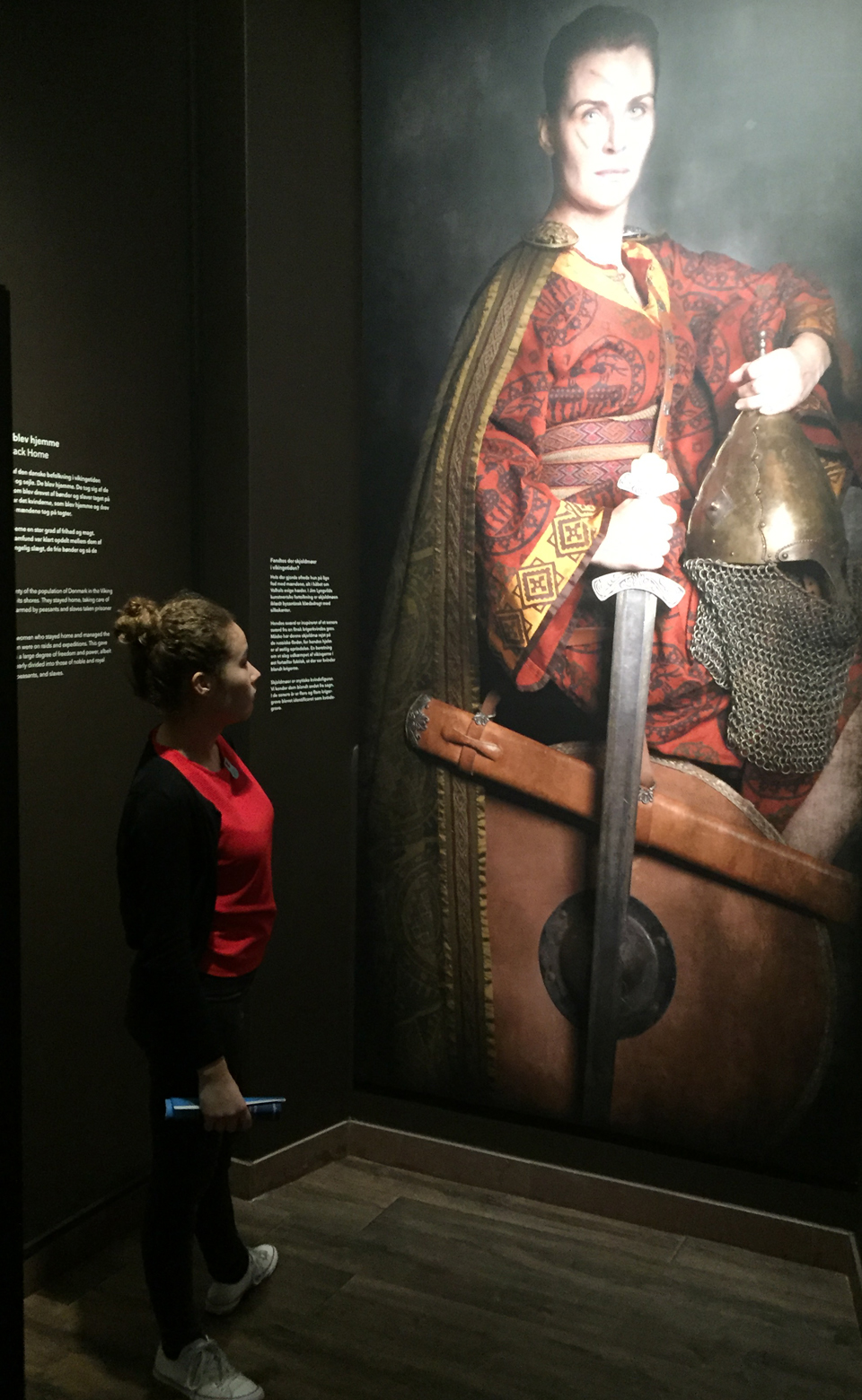
Vikings at the National Museum of Copenhagen

For years, tourists have been puzzled by the “Absent Vikings” at the National Museum in Copenhagen. A revamp of the relevant part of the Prehistory exhibition has caused an uproar among historians and archaeologists. Is this fair?

Girl looking at Poster by Jim Lyngvild © Karen Schousboe/CC by 4.0
Girl looking at poster by Jim Lyngvild © Karen Schousboe/CC by 4.0

Absentee Vikings have for a long time puzzled innocent tourists visiting the National Museum in Copenhagen. Where are the Vikings, one might occasionally hear them ask the guide, who would in accordance with the official, though, unwritten policy politely answer, that in fact, Vikings were a romantic notion. In Denmark, there existed a late iron age before the Middle Ages would take over some time in the late 10thcentury, he or she would explain.

Hence, all the love lavished on the Stone Age, the Bronze Age, and the Iron Age had been allowed to peter out on the threshold of that which in a European context would be considered the High Middle Ages. To quote from the official website, the exhibition – The prehistoric period – presents the archaeological treasures from the period up to AD 1050. This, despite the fact that Denmark formally entered the written history of Europe at the end of the 8thcentury, when King Godfred according to the Royal Frankish Chronicles acted as a friend to the Saxons and a significant foe of Charlemagne. Carried out together with Norwegian and Swedish Vikings, followed the Viking conquests of the Danelaw, Ireland, and Normandy. In the end, the Danish King, Cnut the Great, ended up ruling England, Ireland, Norway and Denmark in what has been widely regarded as a mighty Northwestern Viking Empire.

But no, this story had no place at the National Museum in Copenhagen in 2005, when the exhibition for Prehistory was curated anew. We may speculate why? Was it a reflection of an on-going internecine strife between on one hand the “old” prehistorian archaeologists in Copenhagen and on the other hand, the youngsters studying Medieval Archaeology in Århus under the supervision of Else Roesdahl, known for her well-regarded book on the Vikings? Or was it more of a question of the academic conviction that Vikings were a misnomer for “Iron-Age” people living between the second half the 6thcentury and until c. 1050/1080? Which, in fact, is a sympathetic position to hold on to as these people seemed to exhibit a cultural continuity in terms of religion, art, ways of life and perhaps social organisational forms. (Hence, it has recently become more fashionable to let the Viking Age “start” earlier and earlier; however, that is another story).

New Exhibition Planned

The last few years have shown that such finicky considerations have no appeal in a world dominated by HBO and the Internet. At the same time, powers-that-be have discovered that Vikings are a branded commodity, which sells valuable tickets to tourists. Thus, Oslo is currently re-building the home of their magnificent finds from Gokstad and Oseberg, while Uppsala has revamped their exhibition of the finds from the Vendel Era. At the same time, the University in Uppsala have found funding for a huge and very important research project The Viking Phenomenon. Meanwhile, the wrecks of the Viking Ships in the Firth of Roskilde in Denmark are in danger of being swept away during the next winter storm, while the discovery of the Vikings in Copenhagen have seemed like locating a needle in a prehistoric haystack.

New Director and New Ideas

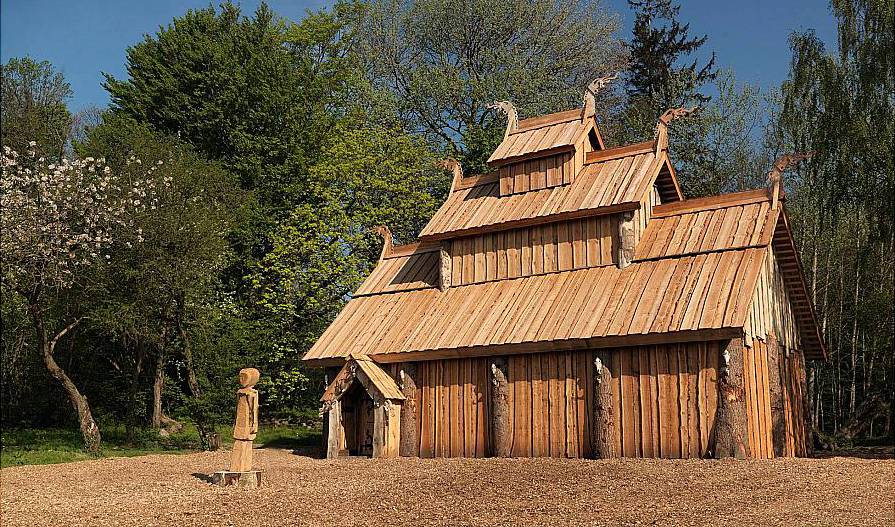
Pagan Temple at Funen, built by Jim Lyngvild © Jim Lyngvild

In 2017 the Anthropologist, Rane Willerslev, took up the position as director of the National Museum in Copenhagen. Known for his “Wild Thinking”, he soon took it upon himself to sweep just a bit of the cobweb under the floorboards of the venerable 18thcentury “Mansion of the Princes”, which houses the museum. Although severely hampered by financial cuts, he soon decided to make a home for a large permanent Viking exhibition planned to open in a couple of year’s time. As a precursor, he decided to do something about the dissatisfied tourists and proceeded to revamp the three rooms, where the Vikings had been carefully hidden from the view of the non-initiated. Also, the intention was probably to try out a more daring and “wild” approach before going full-scale at a later time.

To this end, he struck up collaboration with a kindred spirit, a wild designer, Jim Lyngvild, known for being an aficionado of Vikings as well as the leader of a pagan Norse Temple on the island of Fyen. As Lyngvild also runs a “Viking Business” selling design and cosmetics, he volunteered to be the creative designer of the exhibition for nothing except expenses. Quid Pro Quo!

The Exhibition

As it stands, the exhibition consists of three rooms, of which the first has hardly been touched. In one end, a phantasy recreation of a pagan temple like the one at Tissø has been attempted. The two following rooms present a mixture of a number of large oversized posters presenting “archetypal” Vikings as imagined by Jim Lyngvild. These are paired with a rather traditional exhibition of all that glitters – hoards and jewellery galore.

A couple of weeks ago the exhibition was launched with considerable fanfare. HBO was invited to the grand opening, which the company used to launch the second part of the fifth season of “Vikings”. As was anyone, who wished to pay for a ticket for the party. Obviously copied from the world of media and entertainment, the idea was to turn the old-fashioned and somewhat dreary and academic unveiling of a new museum exhibition into a show where the high and mighty might hobnob with the “influencers”, Viking re-enactors, and media people, while drinking “Wings of Orkney’ Cocktails based on “Highland Park Valkyrie”. At the event, the director, Rane Willerslev, obviously fought an uphill battle to blend at least some respectability into the happening. To say the least, Jim Lyngvild conquered the stage. The proceeding may be seen here below.

Uproar

Wax heads at the Viking Echibition at the National Museum in Copenhagen © Jim Lyngvild
Wax heads at the Viking exhibition at the National Museum in Copenhagen © Jim Lyngvild

To say the least, the collaboration between the National Museum, HBO and Jim Lyngvild has been met with a massive bombardment of comments, reviews, and scorn, bordering on rage on the social media and elsewhere. One explanation is that the Museum just a few weeks before fired 30 people, among them at least one expert on Viking culture and history. Academia felt snubbed and with some rights. Another explanation, though, is the manifestly “wrong” rendering of the Vikings.

During the “proceedings” on Facebook, the photos of Jim Lyngvild has for instance been picked apart and shown to feature copies of artefacts from 3 to 400 years as well as romantic reproductions from the 19thcentury. Clad in sumptuous brocades and silks, there are no “stinking peasants” in the gallery – the expression is Jim Lyngvild’s. Also, the wax-heads are splendidly tattooed, while the filed and probably coloured teeth do not seem to feature. While we know, they maltreated their teeth, we don’t know whether the Vikings were actually tattooed. And on it went…

Review

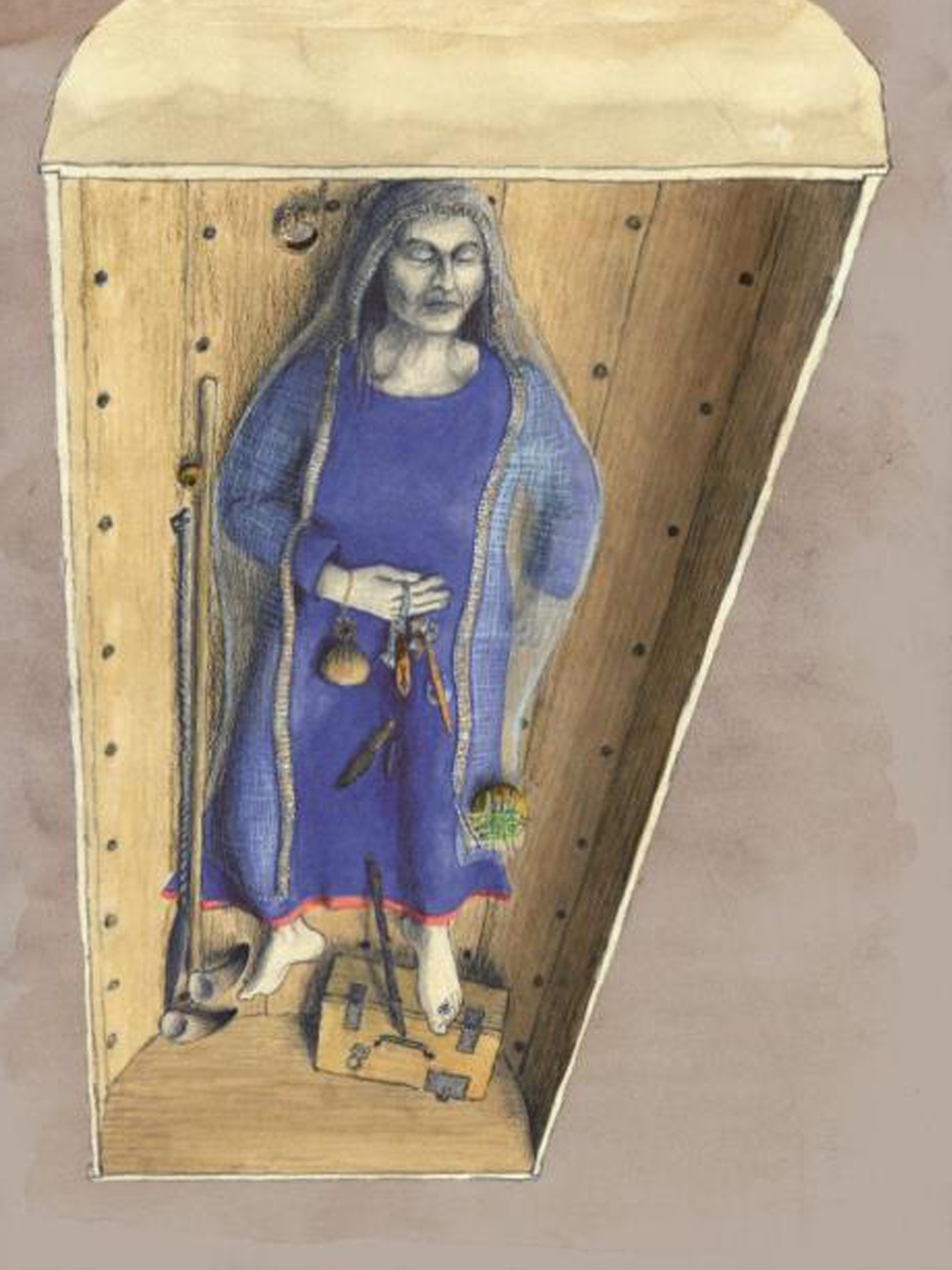
The Buried Voelve from Fyrkat © Natmus
The Buried Voelva from Fyrkat as reconstructed by the National Museum © Natmus
The Voelve as imagined by Jim Lyngvild © Karen Schousboe/cc-by-4.0
The Voelva as imagined by Jim Lyngvild © Karen Schousboe/cc-by-4.0

The question, though, is what we should think of the exhibition.

To begin with, we should not doubt that the intentions are all good. Rumour has it that an American tourist, who in 2013 saw a steel-skeleton exhibiting the fragments of the huge Viking ship, wreck 6, marvelled at the technological expertise of the Vikings in their ability to build ships of steel! Most people visit such exhibitions with no prior background or knowledge except what they may have gleaned from shows like HBO’s Vikings. To plunge them into a traditional exhibition of “things put upon things” will profoundly discourage them. It is like insisting to set up a modern concert house and then proceed to perform nothing but monophonic works when people have been accustomed to listen to grand polyphonic compositions. In the 21stcentury, we binge on Netflix and expect other forms of entertainment to live up to some of the kick, we get out of watching series like The Last Kingdom, The Tudors and Vikings.

So what to do? By creating a whacked-out vision of what a Viking might look like, one might imagine that a visitor would love also to open his or her eyes to what we think it really felt like living as a Viking?

Following down this path, though, the challenge becomes two-fold. The dreamy vision (like those of Jim Lyngvild’s) would at least have to be accompanied by a faithful reproduction of what we think Vikings really looked like (as best we can). Perhaps try and reconstruct some “heads” like for instance that of Gorm buried beneath the Jelling church. Also, we should at least have to try out old-fashioned models and reproductions, or better still, virtual reality to help people to a satisfying experience.

This has not been attempted. Instead, the curators have accompanied the grand posters and the Viking wax heads with collections of hoards of fabulous silver and gold ornaments, which no one with a normal eyesight will be able to enjoy properly. With no magnifiers in sight, and signs written with white on black and small typos in a murky atmosphere, I gave up studying the exhibited objects in detail. At least, we might ask, where is the app, with close-up photos of the exhibited treasures and fitted with proper explanations, fit for the uninitiated? In short, while Jim Lyngvild had been allowed his fun, the curators had apparently been swept aside or left clueless. Which we know, they are not.

In the years to come, the Viking experts at the museum will hopefully get their reprieve followed by a pardon, while Jim Lyngvild is allotted a less prominent role to play in the plans for the grand exhibition, which is in the pipeline. The work of Jim Lyngvild is both fascinating and hilarious. And visitors obviously enjoyed the fun. But it needs a serious dialogue partner in order for the National Museum of Copenhagen to fulfil its proper role, which is to tell the magnificent story of the Vikings, ca. 600 – 1080.

We live in hope…

VISIT:

Putting a Face to the Vikings
The National Museum in Copenhagen
Ny Vestergade 10, Copenhagen

HEAR MORE:


The post Vikings at the National Museum of Copenhagen appeared first on Medieval Histories.

Powered by WPeMatico

Did Climate Change Foster the Decline and Fall of the Western Roman Empire?

The story of the Decline and Fall of the Roman Empire has in recent years been more and more considered as a reflection of 4thcentury widespread draughts on the Eurasian Steppes, the wanderings of the Huns, and the forced migration of the Germans. The questions raised in an exceedingly important meta-study of the literature is to what extent the facts fit with the history?

REVIEW:

Climate and the Decline and Fall of the Western Roman Empire: A Bibliometric View on an Interdisciplinary Approach to Answer a Most Classic Historical Question
By Werner Marx, Robin Haunschild, and Lutz Bornmann.
In: Climate, Vol 6, No 5
Open Access

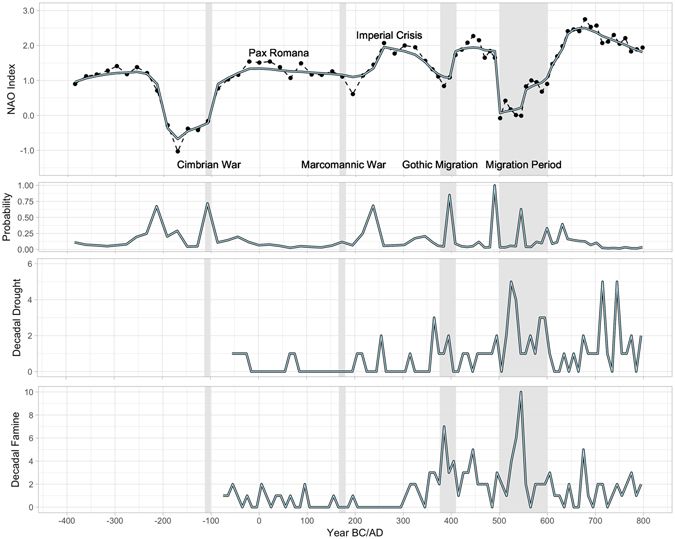
Bayesian change point analysis of NAO and historical accounts of droughts and famine with primary migration events. Figure generated in R (3.3.2) by © B. Lee Drake From: Changes in North Atlantic Oscillation drove Population Migrations and the Collapse of the Western Roman EmpireBayesian change point analysis of NAO and historical accounts of droughts and famine with primary migration events. Figure generated in R (3.3.2) by © B. Lee Drake From: Changes in North Atlantic Oscillation drove Population Migrations and the Collapse of the Western Roman Empire
Bayesian change point analysis of NAO and historical accounts of droughts and famine with primary migration events. Figure generated in R (3.3.2) by © B. Lee Drake
From: Changes in North Atlantic Oscillation drove Population Migrations and the Collapse of the Western Roman Empire. In: Nature (2017). Scientific reports Vol 7, Article No 1227

Most historians interested in the rigor mortis of the Late Antiquity and the transition to the Early Middle Ages have acquainted themselves with the ground-breaking work of Ulf Büntgen, and Michael McCormick outlining the calamitous climatic events following the Roman Optimum.

But what exactly are the facts behind these and several other studies published during the last decades? And how do we get an overview of what is firm evidence, and what are suppositions? Enter the recent study by Werner Max, Robin Hauschild, and Lutz Borman, who has carried out something as exotic as a bibliometric analysis. About the method applied, they write in the abstract:

“Based on the Web of Science (WoS) database, we applied a combination of three different search queries for retrieving the relevant literature: (1) on the decline and fall of the Roman Empire in general, (2) more specifically on the downfall in connection with a changing climate, and (3) on paleoclimatic research in combination with the time period of the Roman Empire and Late Antiquity. Additionally, we considered all references cited by an ensemble of selected key papers and all citing papers of these key papers, whereby we retrieved additional publications (in particular, books and book chapters). We merged the literature retrieved, receiving a final publication set of 85 publications. We analyzed this publication set by applying a toolset of bibliometric methods and visualization programs.”

Applying these methods, such meta-studies are well known from the medical sciences, but as to the best of my knowledge, this is the first time they have been applied to a humanistic field; and more specifically one, which is as contested as the one dealt with here. Scholars and scientists familiar with the questions about “The Decline and Fall” will know that positions range from historians, claiming it never to place, to those who believe the shifts were tectonic in nature. Thanks to the newly published article by Werner Marx and his co-authors, we are now able to get a solid overview of the debates, the climatic indicators and proxies, as well as the problems encountering historians working in this relatively new field of research.

So what are the findings?

According to multiple studies of paleoclimatic data-sets, a climatic shift did indeed take place sometime after the Roman Optimum, when a favourable climate was arguably decisive for the growth of the Roman Empire. This was caused by a solar maximum, which had set in ca. 150 BC. Sometime after AD 250–400, however, the climate turned unstable. The probable reason was the sun-induced melting of Arctic Ice, gradually depressing the Gulf Stream, which moves hot water from the Gulf of Mexico and Bermuda. We know that this probably contributes to a shift in the path of the upper atmospheric yet-streams – the so-called North Atlantic Oscillation – turning the climate into something like what we are currently experiencing in present-day Europe: Hot, and dry summers, followed by cold winters (with obvious variations across the continent). Most of all, though, the weather turned increasingly volatile. “At the risk of oversimplifying”, the authors conclude that, yes, the climate archives reveal, there was indeed a Roman Climate Optimum, which was followed by a Migration Period Pessimum (a phrase first coined in 2008).

Exactly when this deterioration of climate set in, however, is somewhat contested. Some claim that this shift set in, ca. 150 and thus coincides with the Marcomanic Wars (AD 166 – AD 180), others ca. 250, and yet some scientists indicate ca. 400 as the tipping point. As the height of the migration period arguably set in during the 4thcentury, this has repercussions for the historians trying to argue for a series of climate-driven events, from The Marcomanic Wars (AD 166 – AD 180) to the crossing of the frozen River Rhine on New Year’s Eve AD 406. Others claim a more fundamental convergence of events, cobbling the deterioration of the climate with severe droughts on the Eurasian Steppes, pushing in the 4th century the Huns to the frontiers of their habitat, propelling the Germanic people in front of them. But if the deterioration set in as late as ca. 400, this line of argument is faulted from the beginning.

The authors find that this lack of precise knowledge hampers the specific conclusions, which may be reached, and add: “We do not want to advocate for simple or reductionist theories – we do not know if the fluctuations of the climate were a triggering factor; the data only deliver a possible connection,” they prudently write. They are well aware of the fact that simple causality is impossible to outline, simply because the “Decline and Fall” took place over several centuries and involved multiple groups of different people reacting to as diverse climatic conditions as a humid North Germania and an arid Mediterranean region. Having said that, the authors carefully call for more detailed interdisciplinary studies of how it all played out locally and temporally. History is the story of how people react to the events happening in their immediate surroundings. Among these, climatic events may be decisive. Not least when they present themselves in a pre-modern context as three or more years of prolonged excessive draught or humidity. In order to move ahead, we need more local studies of local climate change and changes in settlement patterns as those which for instance have been carried out in Sweden following the events of AD 536  or the studies by Armin Volkmann of the events in the Oder region in Northern Germany.

The Bibliometric Approach

Historians may enjoy this study for its precise and “cool” overview of the present status quo of the debate concerning the linkage between the “Climate” and the “Decline and Fall”. As the authors write, however, bibliometric approaches are also valuable because they avoid the bias involved in more traditional “state of the art” synopses of any literature, we are so familiar with. On the other hand, the method is hampered by the fact that humanistic scholars still seem to write books, which are not generally refereed in such large databases as WoS or Scopus. In the present study, though, this was compensated for by taking into consideration the bibliographic links in the ten most quoted articles and chapters in books, from which the 85 were recruited. The article is highly recommended.

Below is a list of the ten must-reads, which this important paper links to. The remaining 85 papers are listed in the article.

Karen Schousboe

READ MORE:

The Fate of Rome: climate, disease, and the end of an empire.
By A Moravcsik
In: ForeignAffairs97(1),160-160(2018)

Approaches to the environmental history of Late Antiquity, part II: Climate Change and the End of the Roman Empire.
By M. J. Decker
In History Compass (2017) vol 15, No 2.

Changes in North Atlantic Oscillation drove Population Migrations and the Collapse of the Western Roman Empire
By B. Lee Drake
In: Nature (2017). Scientific reports Vol 7, Article No 1227

Rome and the Classic Maya: Comparing the Slow Collapse of Civilizations
By Rebecca Storey and Glenn R Storey
Routledge 2017

The Environmental Fall of the Roman Empire
By Ken Harper
In: Dædalus (2016), Vol 145, No 2, pp. 101 -111.

The environmental, archaeological and historical evidence for regional climatic changes and their societal impacts in the Eastern Mediterranean in Late Antiquity
By Adam Izdebski, Jordan Pickett, Neil Roberts, and Tomasz Waliszewski.
In: Quaternary Science Reviews, Volume 136, p. 189-208.

Climate Change during and after the Roman Empire: Reconstructing the Past from Scientific and Historical Evidence
By Michael McCormick, Ulf Büntgen, Mark A. Cane, and Edward R. Cook,
In: Journal of Interdisciplinary History (2012) Vol 43, No 2, pp.169-220

2500 years of European climate variability and human susceptibility.
By U. Büntgen U, W. Tegel, K. Nicolussi, M. McCormick, D. Frank, V. Trouet, J. Kaplan F. Herzig, U. Heussner, H. Wanner, J. Luterbacher and J. Esper
In: Science (2011) 331: 578-582

Climate change and human history. Some indications from Europe, ad 400-1400.
By Neville Brown
In: Environmental Pollution (1994), Vol 83, No 1–2, pp. 37-4

Climatic Change and Agricultural Exhaustion as Elements in the Fall of Rome
Ellsworth Huntington
The Quarterly Journal of Economics (1917) Vol 31, No 2, pp. 173–208

READ ALSO:

FEATURED PHOTO:

Co-Authorship of all authors (435) from the 85 papers dealing with the fall of Rome or the time period of the Roman Empire in connection with climate change. © Werner Marx et all. Source: WoS/VOS Viewer

More LInks:

The Dust Veil AD 536

Climate and Migrations in Early Medieval Germany

The post Did Climate Change Foster the Decline and Fall of the Western Roman Empire? appeared first on Medieval Histories.

Powered by WPeMatico

An American Journalist Under Castro’s Shadow

by David Ariosto

For David Ariosto, the island of Cuba is an intriguing new world, unmoored from the one he left behind. From neighboring military coups, suspected honey traps, salty spooks, and desperate migrants to dissidents, doctors, and Havana’s empty shelves, Ariosto uncovers the island’s subtle absurdities, its Cold War mystique, and the hopes of a people in the throes of transition. Beyond the classic cars, salsa, and cigars lies a country in which black markets are ubiquitous, free speech is restricted, privacy is curtailed, sanctions wreak havoc, and an almost Kafka-esque goo of Soviet-style bureaucracy still slows the gears of an economy desperate to move forward.

But life in Cuba is indeed changing, as satellite dishes and internet hotspots dot the landscape and more Americans want in. Still, it’s not so simple. The old sentries on both sides of the Florida Straits remain at their posts, fists clenched and guarding against the specter of a Cold War that never quite ended, despite the death of Fidel and the hand-over of the presidency to a man whose last name isn’t Castro.

And now, a crisis is brewing.

In This Is Cuba, Ariosto looks at Cuba from the inside-out over the course of nine years, endeavoring to expose clues for what’s in store for the island as it undergoes its biggest change in more than half a century. Keep reading for an excerpt.

* * * * *

I sipped an amber rum. Habana Club. Seven years. No ice. He palmed a Bucanero beer, half wrapped in a flimsy white paper napkin. Curls of Cohiba smoke wafted between us, giving the room a translucent look and an acrid taste. Castro was having a drink. And so was I. It was a Friday evening in late November 2010, and we were ensconced on opposite ends of a small subterranean saloon on the western outskirts of Havana. It was my last night in Cuba.

Jammed in the crevices of my back pocket was a one-way ticket to Miami, scheduled for the following morning, the first leg of a connecting flight to New York City. For the past year and a half, Havana had been home during my stint as a photojournalist for CNN on an island still forbidden to most Americans. But now I was ready to leave—forever, I thought. My father, who lived in the pinelands of southern New Jersey, had been sick following acute kidney failure, which punctuated my own recognition that life in Castro’s Cuba didn’t much suit me anymore. So I had found a job as an editor in New York, exchanged my house on the Caribbean for a studio apartment on Manhattan’s Upper East Side, and traded the guayabera for a suit and tie; Cuban heat for a wintry chill. Crazy, it seemed, but Gotham was beckoning.

Then again, this was my last night in Havana. Better make the most of it.

“Do you know who that is?” whispered Antonina, a server in La Fontana, the private, family-run restaurant, or paladar, to which that smoky bar was attached.

“No,” I replied. “Who?”

There was usually a breezy familiarity in the way she spoke, imbued with a Caribbean warmth and that marbles-in-your-mouth accent for which much of Cuba is known. The banter was usually light. The topics rarely serious.

But tonight was different. Antonina seemed different, the burden of her words a bit heavier than usual. Inside that paladar, a steady crop of regulars had shuffled in. Rum and cigars, coupled with a live singer or guitarist, usually helped to lighten the mood. But tonight, a palpable tension gripped the air. And the staff seemed to feel it. It was a sensation to which many had grown accustomed.

Situated on a leafy street a few blocks from Havana’s rocky northern coast, La Fontana had opened in 1995 when authorities still investigated private restaurants for their numbers of tables and chairs (more than twelve could provoke a raid). Its clandestine feel—there was no sign outside and a surrounding stone wall all but hid the restaurant from view—was part of a broader bid for its very survival. And it looked it. The Castro government had almost never regarded privatization kindly, granting business licenses only when economic forces compelled a drip of liberalizing reform. But in the aftermath of the Soviet collapse, a financial crisis had ensued. For decades, Cuba had relied on subsidies from Moscow. In their absence, it teetered on the brink of collapse. Absent his old Kremlin ally, Fidel looked inward for answers and reluctantly allowed a few private restaurants to surface in a fraught attempt to gin up local commerce. La Fontana’s two owners, Horacio Reyes-Lovio and Ernesto Blanco, were among the beneficiaries of the new tone and would soon become successful restaurateurs—a dangerous prospect on an island dominated by Communist hard-liners who had spent their careers fending off “yanqui capitalists.” New concentrations of wealth were forming that could undermine the Revolution. So the two businessmen kept their profiles low and were quietly, if not begrudgingly, allowed to thrive. Perhaps even government officials were loath to shut down one of the few haunts where they could still score a decent meal.

By the time I arrived in Havana, in June 2009, that old paladar had been transformed into a favorite hangout for politicians, their staffs, and foreign businesspeople alike. It was a place to eat, drink, and—in my case—write, mostly from the vantage point of a still somewhat naïve American journalist. A fixture there, I’d often scratch out pages alone atop one of the few polished wooden tables in back, filling a leather-bound notebook with run-on sentences, notes, and smears of blue ink. They were random observations, mostly. A sort of blind attempt to piece together this confounding puzzle of a nation that I now called home. His approach. Her look. Their meeting. A dribble of insight that seeped through the censors of state-run newspapers.

Typical street in old La Havana, Cuba. Photo Credit: Christophe Meneboeuf
(Creative Common CC-BY-SA License)

After a few months and what amounted to a few notebooks full of mostly useless pages, I had gotten to know the restaurant’s staff. One was Antonina, whose frankness and sharp tongue seemed matched only by her curiosity. It was the former that made us friends and the latter that would drive her to leave the island as a refugee. But before she did, her occasional rum-topped whispers would help fill in my own knowledge gaps, chasms really, when it came to Cuba. Men like Ricardo Alarcon, then president of Cuba’s National Assembly, were among La Fontana’s well-heeled patrons who often chatted and sipped mojitos with a hardy crop of familiar faces. I’d try without much luck to listen in, attempting to discern with whom he was meeting and what they were discussing. Business could be conducted this way, and the eavesdropping went both ways.

But tonight, my last night, I wondered why Antonina was so serious and to whom she had so subtly pointed. Passing behind me with a tray of empty glasses, she leaned into my ear.

“That’s Alejandro,” she whispered, brushing back the unkempt strands of raven-colored hair that dropped in front of her face.

By “Alejandro,” Antonina had meant Alejandro Castro Espín, a colonel within Cuba’s powerful Interior Ministry and a member of the Castro family, whose inherited importance seemed to be out- pacing much of the rest of the Castro clan’s. It was President Raul Castro’s only son who now sat across from me at the bar. How could I not have realized that before? Of course, in November 2010, the extent of Alejandro’s importance was not yet clear. He had yet to broker secret deals in Ottawa and Toronto with top Obama advisers Ben Rhodes and Ricardo Zúñiga, nor had he presided over a spy-for-spy negotiation that would lay the groundwork for détente. What was clear was that Alejandro was already a player and a de facto top adviser to his father. More importantly, he was rumored to be gaining in power atop the senior echelons of the very agency tasked with Cuba’s surveillance and counterintelligence; his ministry spied on journalists and dissidents alike. And by apparent coincidence, in my final hours in Cuba he sat across from me, slouched over a beer.

“Coño!” exclaimed Rafa—employing his favorite Cuban expletive— when I later told him of the encounter. Rafael, or “Rafa” for short, was a driver at CNN, and his eyes bulged as he pronounced just the ño in that typical Cuban habit of dropping whole syllables. Though he quickly recuperated, casually popped his shoulders, and gave me this simple—though at the time nonsensical—explanation:

“This is Cuba.”

I had come to loathe that line, which was by now all too familiar—a favorite amongst those who seemed intent on explaining the unexplainable. In literal terms it meant little. Yet it also perfectly encapsulated everything about Cuba that was maddening, unknowable, and completely out of your hands. Even Cubans without a basis for comparison seem to know, perhaps by way of the trickle of information that seeps in from outside, that their island is somehow different.

“This is Cuba.”

That Alejandro Castro Espín, one of the very men responsible for the sort of paranoid patina that coats the island, just so happened to be seated at my go-to bar on my last night in Havana . . . yeah, “This is Cuba” seemed apt.


DAVID ARIOSTO is Executive Producer of GZERO media at the Eurasia Group. Previously, he has worked for Brut, CNN, NPR, Al Jazeera America, Reuters and National Geographic. Between 2009 and 2010, Ariosto was based in Havana, Cuba, working as a photojournalist for CNN. He continues to make reporting trips to the island several times each year. Ariosto also holds a Master’s of Public Policy degree from George Mason University and a Bachelor’s of History degree from the University of Massachusetts-Amherst. He lives in New York.

The post An American Journalist Under Castro’s Shadow appeared first on The History Reader.

Powered by WPeMatico
Austrvegr

In Austrvegr: The Role of the Eastern Baltic in Viking Age Communication across the Baltic Sea
By Marika Mägi
BRILL 2018

ABSTRACT


Marika Mägi’s book considers the cultural, mercantile and political interaction of the Viking Age (9th-11th century), focusing on the eastern coasts of the Baltic Sea. The majority of research on Viking activity in the East has so far concentrated on the modern-day lands of Russia, while the archaeology and Viking Age history of today’s small nation states along the eastern coasts of the Baltic Sea is little known to a global audience.

This study looks at the area from a trans-regional perspective, combining archaeological evidence with written sources, and offering reflections on the many different factors of climate, topography, logistics, technology, politics and trade that shaped travel in this period. The work offers a nuanced vision of Eastern Viking expansion, in which the Eastern Baltic frequently acted as a buffer zone between eastern and western powers.

TABLE OF CONTENTS:

1 Viking Age Cultural Contacts across The Baltic Sea: Behind the Interpretations
1.1 The Evolutionary Development Model
1.2 Eastern Baltic Archaeology and the Concepts of Different Cultural Impacts
1.3 The Character of Communications across the Baltic Sea
1.4 Conclusions

2 Clan-Based Collectivists or Hierarchical Individualists? Late Prehistoric Societies in the Eastern Baltic
2.1 Finland
2.2 Estonia
2.3 Latvia and Lithuania
2.4 Prussia
2.5 Comparing Social Systems in Different Regions in the Eastern Baltic
2.6 Conclusions

3 Making Trade: Cultural Landscapes and Communication Routes
3.1 Maritime Landscapes in Countries around the Baltic
3.2 Long-distance Trade Routes through the Eastern Baltic
3.3 Travelling along Viking Age Routes
3.4 Points in Communication
3.5 Different Modes of Communication in the Eastern Baltic
3.6 Conclusions

4 The Historical Reality: Places, Place Names, and Ethnonyms in Written Sources
4.1 Estland(s) in the East
4.2 Pre-viking and Viking Age Eastern Baltic in Scandinavian Sources
4.3 What Was Rus’?
4.4 Languages and Personal Names
4.5 Conclusions

5 Networks Take Shape: Communication Through the Eastern Baltic 600–850
5.1 Cultural Situation around the Northern Part of the Baltic Sea
5.2 Viking Colonies in the Southern Half of the Eastern Baltic
5.3 Pre-Viking Period Hill-Forts and Trade Centres along the Eastern Baltic Coast
5.4 Conclusions

6 West Goes East: Viking Age Long-distance Communication and the Eastern Baltic 850-ca. 1000
6.1 Viking Age Centres Connected with International Trade Routes in the Eastern Baltic
6.2 Cultural Landscapes along the Eastern Way
6.3 Cultural Landscapes in the Middle Part of the Eastern Baltic
6.4 Coin Finds in the Eastern Baltic
6.5 Interpreting Routes and Centres in the 9th–10th Centuries
6.6 Conclusions

7 Between Consolidating States. The Eastern Baltic Areas in the 11th and 12th Centuries
7.1 Interaction with Scandinavian Kingdoms
7.2 Northern Eastern Baltic in the Final Centuries of Prehistory
7.3 The East Attacks
7.4 Landscapes around the Daugava Route
7.5 Southern Couronian Coast
7.6 Coins and Trade
7.7 Conclusions

8 Summing up and Conclusions
8.1 Two Cultural Spheres in the Eastern Baltic
8.2 The Shared Cultural Sphere of Warriors
8.3 Written Sources and Places on the Eastern Coasts of the Baltic Sea
8.4 Different Periods in the Viking Age

ABOUT THE AUTHOR:

Marika Mägi, PhD (2002), Tartu University, is a senior research fellow at the Centre for Medieval Studies at Tallinn University. She is an archaeologist and historian and has published mainly on Viking Age and Middle Ages in Estonia and neighbouring areas.

The post Austrvegr appeared first on Medieval Histories.

Powered by WPeMatico

Silver, Butter, Cloth – Economies in the Viking Age

Silver, coins, pendants, and jewellery were not the only types of valuables in the Viking Age. Butter and cloth were also significant elements in the Viking economy

Silver, Butter, Cloth: Monetary and Social Economies in the Viking Age
Series: Medieval History and Archaeology
By Jane Kershaw, Gareth Williams, Søren Sindbæk, and James Graham-Campbell

ABSTRACT


Silver, Butter, Cloth advances current debates about the nature and complexity of Viking economic systems. It explores how silver and other commodities were used in monetary and social economies across the Scandinavian world of the Viking Age (c. 800-1100 AD) before and alongside the wide-scale introduction of coinage. Taking a multi-disciplinary approach that unites archaeological, numismatic, and metallurgical analyses, Kershaw and Williams examine the uses and sources of silver in both monetary and social transactions, addressing topics such as silver fragmentation, hoarding, and coin production and re-use. Uniquely, it also goes beyond silver, giving the first detailed consideration of the monetary role of butter, cloth, and gold in the Viking economy. Indeed, it is instrumental in developing methodologies to identify such commodity monies in the archaeological record.

The use of silver and other commodities within Viking economies is a dynamic field of study, fuelled by important recent discoveries across the Viking world. The 14 contributions to this book, by a truly international group of scholars, draw on newly available archaeological data from eastern Europe, Scandinavia, the North Atlantic, and the British Isles and Ireland, to present the latest original research. Together, they deepen understanding of Viking monetary and social economies and advance new definitions of ‘economy’, ‘currency’, and ‘value’ in the ninth to eleventh centuries.

TABLE OF CONTENTS:

Introduction, Jane Kershaw
1: Silver Fragmentation: Reinterpreting the Evidence of the Hoards, Marek Jankowiak
2: As Long as it Glitters. A Re-evaluation of the Mixed Silver Hoards of Bornholm, Denmark, Gitte Tarnow Ingvardson
3: On Silver Fragmentation: How Reliable is Metrological Data? A Case Study Based on the Mózgowo Hoard, Poland (tpq 1009), Mateusz Bogucki
4: Royalty and Renewal in Viking-Age Ireland, Andrew R. Woods
5: The Rise of Spiritual Economies in late Viking and Early Medieval Scandinavia, Svein H. Gullbekk
6: Reflections on Kingship, the Church and Viking-Age Silver in Ireland, John Sheehan
7: Beyond Economics: The Use of Coins as Pendants in Viking Age Scandinavia, Florent Audy
8: A Viking-Age Gold Hoard from Essu, Estonia: Context, Function and Meaning, Ester Oras, Ivar Leimus, and Lauri Joosu
9: The Importance of Containers for the Deposition and Non-Retrieval of Silver Hoards – a comparison between Gotland and Pomerania, Jacek Gruszczynski
10: From Local Supply to Long-Distance Trade Networks: Fingerprinting Early Medieval Silver, Guillaume Sarah
11: Provenancing Viking-age Silver: Methodological and Theoretical Considerations and a Case Study, Stephen Merkel
12: Gold as a Means of Exchange in Scandinavian England (c. 850-1050 AD), Jane Kershaw
13: Vaðmál and Cloth Currency in Viking and Medieval Iceland, Michele Hayeur-Smith
14: Tracing the Late Viking-Age and Medieval Butter Economy: The View from Quoygrew, Orkney, Aaron J. Critch, Jennifer F. Harland, and James H. Barrett

READ MORE:


The post Silver, Butter, Cloth – Economies in the Viking Age appeared first on Medieval Histories.

Powered by WPeMatico

Heirs of the Vikings

Chronicles, hagiographies, and charters tell us different stories of the character and the identity of the Vikings. By comparing the evidence from both England and Normandy, a new book introduces the reader to the complex ways in which Scandinavian heritage was used strategically to cement local politics.

Heirs of the Vikings. History and Identity in Normandy and England, c. 950 – 1015
by Katherine Cross
York Medieval Press 2018

ABSTRACT:

Viking settlers and their descendants inhabited both England and Normandy in the tenth century, but narratives discussing their origins diverged significantly. This comparative study explores the depictions of Scandinavia and the events of the Viking Age in genealogies, origin myths, hagiographies, and charters from the two regions. Analysis of this literary evidence reveals the strategic use of Scandinavian identity by Norman and Anglo-Saxon elites.

Countering interpretations which see claims of Viking identity as expressions of contact with Scandinavia, the comparison demonstrates the local, political significance of these claims. In doing so, the book reveals the earliest origins of familiar legends which at once demonize and romanticize the Vikings – and which have their roots in both Anglo-Saxon and Norman traditions.

TABLE OF CONTENTS:

Introduction: The Problem of a Viking Identity
Genealogy: Building a Viking Age Dynasty
Origin Myths: A People for a Dynasty
Hagiography I: Ruin and Restoration
Hagiography II: Saintly Patronage
Charter Narratives: Normans, Northumbrians and Northmen
Conclusion: Viking Age Narratives and Ethnic Identities
Appendix 1: The Date of Fulbert’s Vita Romani
Appendix 2: The Dates of the Latin Vita Prima Sancti Neoti and the Old English Life of St Neot
Bibliography

FEATURED PHOTO:

Miscellany on the life of St. Edmund, England, ca. 1130. Morgan Library and Museum

The post Heirs of the Vikings appeared first on Medieval Histories.

Powered by WPeMatico