Since the Ice receded for more than 10.000 years, the landscape north of Halmsad in Sweden has changed from a cold Steppe to an ancient forest. New research traces the different phases and explains how the forest at Almeberget looks much like it did at the beginning of the vendel period, c. 500
Swedish Forests. The Reconstruction of past forest dynamics over the last 13,500 years in SW Sweden
By Gene E. Hannon, Karen Halsall, Chiara Molinari, and Richard H. W Bradshaw
In: The Holocene. 10.08.2018
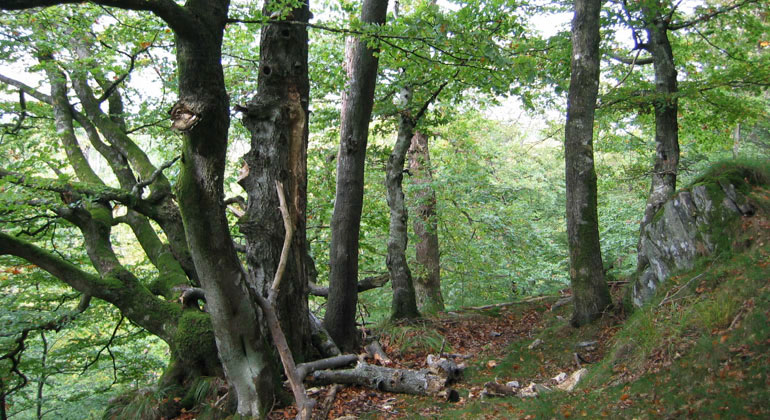
Sweden is known for its forests. Sometimes impenetrable, at other times full of glittering lakes, and always scattered throughout with surfacing bedrock and littered with granite boulders. We tend to think of them as ancient. Recent studies of the sediments in a lake northeast of Halmstad in a national reserve called Almeberget, however, demonstrate that forests and landscapes have histories. It also tells us about how the landscape changed in the late Iron Age on the cusp of the Vendel period. (c. 500)
After the ice receded for more than 13.500 years ago, the landscape was a cold steppe covered by herbs and shrubs. Covered with juniper, buckthorn, crowberries, heather, grass, and various herbs, it slowly transformed into a less open landscape filled with conifer, birch, aspen, and willow. With Holocene warming (c. 9600 – 4000 BC), the landscape changed character. While firs were still predominant, the landscape gradually came to be characterised by a deciduous element of first elms and alder. Later oak, ash, and lime became part of the coverage, as did rowan, and buckthorn. At the end of the Neolithic age hornbeams entered the scene. It was not until the Bronze Age (c. 1800-500 BC) that the beech appeared on the scene, decreasing the role of hazel.
Finally, during the Iron Age and the Early Middle Ages (500 BC – AD 1100) the landscape changed once more. Now beech became prevalent, while other deciduous trees slowly receded. At the same time, spruces became more common. After AD 1100, beeches came to dominate. As they do today, together with spruces planted in the 19thcentury.
Throughout prehistory, wild fires – started by lightening – were recurrent phenomena. Called ‘taigas’ they occurred every 100 years and charcoal would set its mark on the pollen diagrams. Vastly interesting, however, is the fact that they would peak during the late Neolithic period and the early Bronze Age, to peter out at the end of the Roman Iron Age, when climate once more became cooler, wetter, and more turbulent – and less prone to be ignited by lightening. And a probable shift from slash-and-burn or fire cultivation to more permanently fertilized field agriculture.
What we see is the evidence of the combination of wild fires as well as the later widespread introduction of slash and burn agriculture in the Bronze Age, leaving the landscape constantly open for regeneration. When cooling of the weather as well as shifting demographic pressure entered the equation – at the end of the Iron Age and the beginning of the Migration and Vendel Periods c. 400 – 500, beeches would gradually take over. They were simply able to better get a foothold leading to the present characteristic coverage at Almeberget.
What does this tell us in terms of the landscape in this remote corner of Europe. In fact, it informs us is that the landscape – as we may encounter it at the centre of Almeberget today – shows us a type of forest cover not much different from that which peasants from c. AD 500 were accustomed to at the northernmost border between the temperate vegetation zone and the southern Swedish highlands.
The post The History of Forests in Southwestern Sweden appeared first on Medieval Histories.
Powered by WPeMatico